
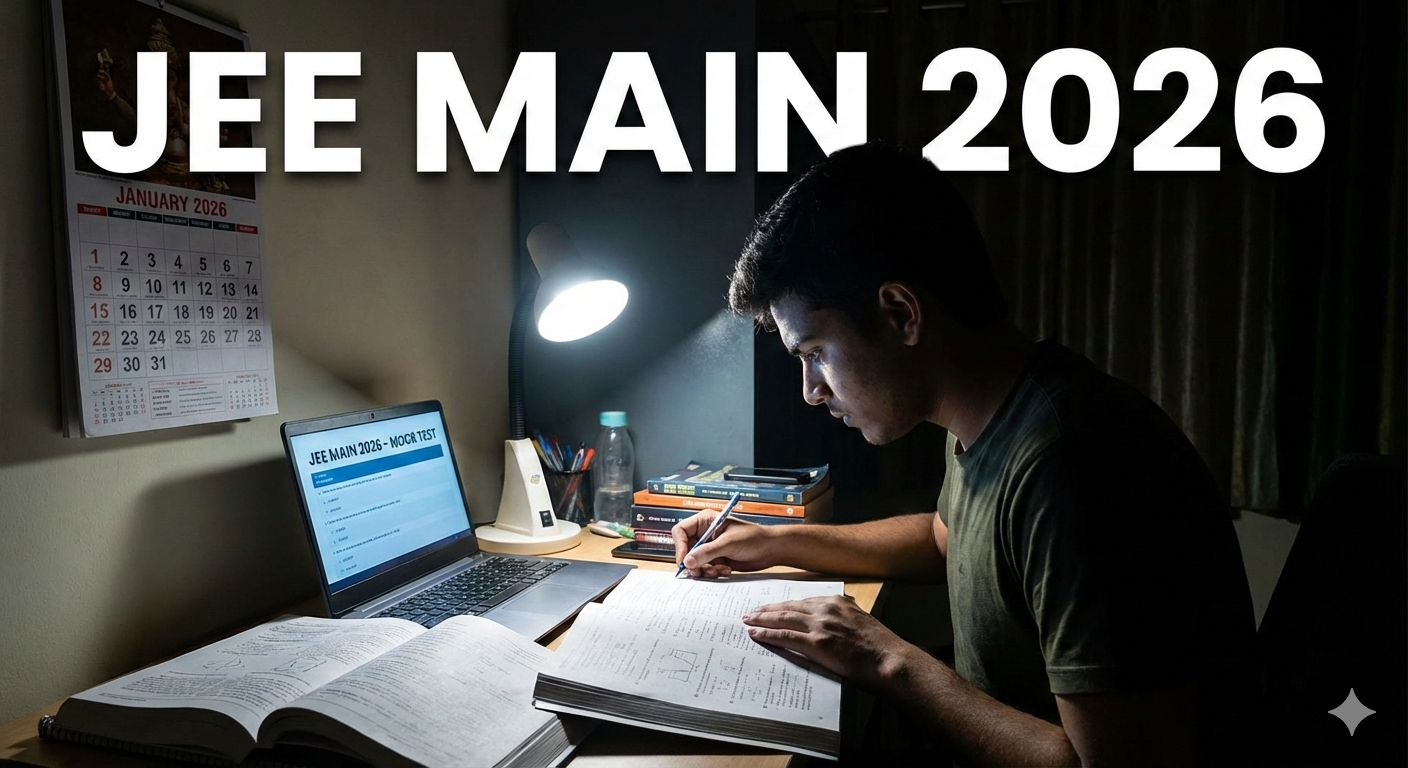
JEE Main 2026: Complete Guide to Eligibility, Syllabus, Exam Pattern, Preparation Strategy & Counselling
JEE Main: The Gateway Exam That Shapes the Engineering Dreams of Millions
Introduction: More Than Just an Entrance Exam
JEE Main 2026,Every year in India, as winter fades into spring and calendars turn to January, a familiar tension fills homes across the country. Study tables are crowded with books, formula sheets are taped to walls, alarm clocks ring earlier than usual, and countless students sit quietly, fighting a mix of hope, fear, and determination. At the center of this storm stands one exam — JEE Main.

JEE Main is not just a test of Physics, Chemistry, and Mathematics. For millions of students, it represents dreams of becoming an engineer, of entering prestigious institutions like NITs, IIITs, and other government-funded technical institutes, and for some, a stepping stone toward the even more challenging JEE Advanced and the IITs.
But beyond ranks and percentiles, JEE Main is an emotional journey. It tests patience, resilience, consistency, and belief. It teaches students how to fail, how to recover, and how to grow. This article explores JEE Main in its entirety — not just as an exam, but as an experience that shapes young minds across India.
The Evolution of JEE Main: From AIEEE to a National Benchmark
Before JEE Main came into existence, engineering aspirants were familiar with the AIEEE (All India Engineering Entrance Examination). Conducted by CBSE, AIEEE served as the primary entrance test for NITs and several other institutions.
However, as competition increased and the number of aspirants crossed millions, the need for a more standardized, transparent, and scalable system became clear. This led to the birth of the Joint Entrance Examination (JEE) structure, divided into JEE Main and JEE Advanced.
The introduction of JEE Main marked a significant shift:
-
Online (computer-based) testing
-
Multiple attempts in a year
-
Normalization to ensure fairness
-
A centralized, national-level assessment
Over the years, the exam has evolved further under the National Testing Agency (NTA), reflecting India’s attempt to modernize its examination system and reduce student stress.
Role of the National Testing Agency (NTA)
The National Testing Agency was established to bring efficiency, transparency, and standardization to large-scale entrance exams in India. JEE Main became one of its flagship examinations.
NTA’s responsibilities include:
-
Designing the exam structure
-
Conducting exams across multiple sessions
-
Ensuring fair normalization of scores
-
Managing applications, admit cards, and results
While debates around normalization and difficulty levels continue, NTA’s role has largely streamlined the process, especially by offering students more than one attempt, allowing them to improve performance without losing an academic year.
What Exactly Is JEE Main?
JEE Main (Joint Entrance Examination – Main) is a national-level entrance exam conducted for admission to:
-
B.E. / B.Tech
-
B.Arch
-
B.Planning
It serves two major purposes:
-
Admission into NITs, IIITs, GFTIs, and participating institutions
-
Qualification gateway for JEE Advanced
Students from all educational backgrounds — CBSE, ICSE, State Boards, and even international boards — appear for this exam, making it one of the largest competitive exams in the world.
Eligibility Criteria: Clearing the Confusion
One of the most common sources of anxiety among students is eligibility. Fortunately, JEE Main eligibility is simple but strict.
Educational Qualification
-
Must have passed Class 12 or equivalent
-
Must have studied Physics and Mathematics as compulsory subjects
-
Chemistry, Biotechnology, Biology, or Technical Vocational subjects accepted as the third subject
Year of Passing
-
Only candidates who passed Class 12 in the recent two years (plus the appearing year) are eligible
Age Limit
-
No age limit for JEE Main (though individual institutions may have age criteria)
Number of Attempts
-
Maximum three consecutive years
-
Two attempts per year → total six chances
This flexibility has helped students plan their preparation better without rushing or panicking.
Exam Pattern: Understanding the Battlefield
Understanding the exam pattern is half the battle won.
Paper 1: B.E. / B.Tech
Subjects:
-
Physics
-
Chemistry
-
Mathematics
Question Types:
-
Multiple Choice Questions (MCQs)
-
Numerical Value-Based Questions
Key Features:
-
Each subject carries equal weight
-
Negative marking for MCQs
-
Numerical questions test conceptual clarity rather than guesswork
Paper 2A: B.Arch
-
Mathematics
-
Aptitude Test
-
Drawing Test
Paper 2B: B.Planning
-
Mathematics
-
Aptitude Test
-
Planning-based questions
This diversified structure ensures students are tested not just on theory, but also on application and aptitude.
JEE Main Syllabus: The Backbone of Preparation
The syllabus of JEE Main is primarily based on NCERT Class 11 and 12, which often surprises students who underestimate textbooks.
Physics
-
Mechanics
-
Thermodynamics
-
Electromagnetism
-
Optics
-
Modern Physics
Physics in JEE Main is known for being formula-based yet concept-driven. Students who truly understand fundamentals often outperform those who rely solely on memorization.
Chemistry
-
Physical Chemistry (numerical-heavy)
-
Organic Chemistry (reaction mechanisms)
-
Inorganic Chemistry (NCERT-focused)
Chemistry is often considered the score-booster, especially for students who thoroughly read NCERT line by line.
Mathematics
-
Algebra
-
Calculus
-
Coordinate Geometry
-
Trigonometry
-
Vectors and 3D Geometry
Mathematics rewards practice, speed, and accuracy. Even strong students struggle without consistent revision.
JEE Main vs JEE Advanced: Clearing the Myth
Many students confuse these two exams or fear one unnecessarily.
| Aspect | JEE Main | JEE Advanced |
|---|---|---|
| Purpose | Admission + Qualification | IIT Admission |
| Difficulty | Moderate to High | Very High |
| Question Style | Objective-focused | Conceptual & Analytical |
| Eligibility | Wide | Limited by JEE Main rank |
JEE Main is about consistency and coverage, while JEE Advanced demands depth and creativity.
Preparation Strategy: A Smart Roadmap
When to Start
Ideally, preparation begins in Class 11, but many successful candidates start seriously in Class 12 or even during a drop year.
Daily Study Routine
-
6–8 focused hours
-
Balanced time for all three subjects
-
Daily revision + problem practice
Coaching vs Self-Study
Coaching provides structure, but self-study decides rank. Many toppers attribute success to disciplined independent learning.
Importance of NCERT
Ignoring NCERT is one of the biggest mistakes aspirants make. A significant portion of Chemistry — and even Physics — is directly NCERT-based.
Subject-Wise Preparation Tips
Physics
-
Focus on understanding concepts
-
Maintain a formula notebook
-
Practice numericals daily
Chemistry
-
Read NCERT repeatedly
-
Understand organic mechanisms
-
Memorize inorganic trends
Mathematics
-
Practice is non-negotiable
-
Time-bound question solving
-
Analyze mistakes carefully
Mock Tests & Previous Year Questions: The Game Changers
Mock tests simulate real exam pressure. But simply attempting them is not enough.
Students must:
-
Analyze mistakes
-
Identify weak chapters
-
Improve time management
Previous Year Questions (PYQs) reveal patterns, frequently asked topics, and the true level of JEE Main.
Percentile, Rank & Normalization Explained Simply
One of the most misunderstood aspects of JEE Main is percentile.
-
Percentile indicates how many candidates you performed better than
-
Normalization adjusts difficulty variations across sessions
-
Rank is calculated after combining all sessions
This system ensures fairness, even if papers differ slightly in difficulty.
Cut-Offs: What Do They Really Mean?
Cut-offs vary each year based on:
-
Number of candidates
-
Difficulty level
-
Seat availability
Qualifying cut-offs decide eligibility for JEE Advanced, while admission cut-offs depend on college and branch choices.
Counselling & Admission Process
Admissions through JEE Main happen via:
-
JoSAA Counselling
-
CSAB Counselling
Key steps include:
-
Choice filling
-
Seat allocation
-
Document verification
Students often lose good seats due to poor choice filling, making counselling strategy as important as rank.
Life of a JEE Aspirant: The Untold Reality
Behind every rank is a story:
-
Late-night revisions
-
Family sacrifices
-
Self-doubt and pressure
-
Fear of disappointing parents
Mental health struggles are real. Burnout, anxiety, and comparison can drain confidence. Successful aspirants learn to pause, breathe, and trust the process.
Common Myths About JEE Main
-
“Only geniuses crack JEE” – False
-
“Coaching guarantees success” – False
-
“Droppers fail” – False
-
“One exam decides life” – Absolutely false
JEE Main tests preparation, not intelligence or worth.
Droppers: A Second Chance, Not a Step Back
A drop year can be powerful if used wisely. Many top rankers are droppers who corrected mistakes, strengthened basics, and built discipline.
Beyond JEE: Life Doesn’t End Here
Even if things don’t go as planned:
-
Engineering still offers multiple paths
-
Skills matter more than college names in the long run
-
Success has many definitions
JEE Main is a path, not a prison.
Conclusion: Redefining Success
JEE Main is tough, no doubt. But it also teaches lessons no classroom ever could — discipline, resilience, and self-belief. Whether a student scores a top rank or just clears the exam, the journey itself builds character.
In the end, a rank does not define a student — the effort does. And that effort, once learned, stays for life.