


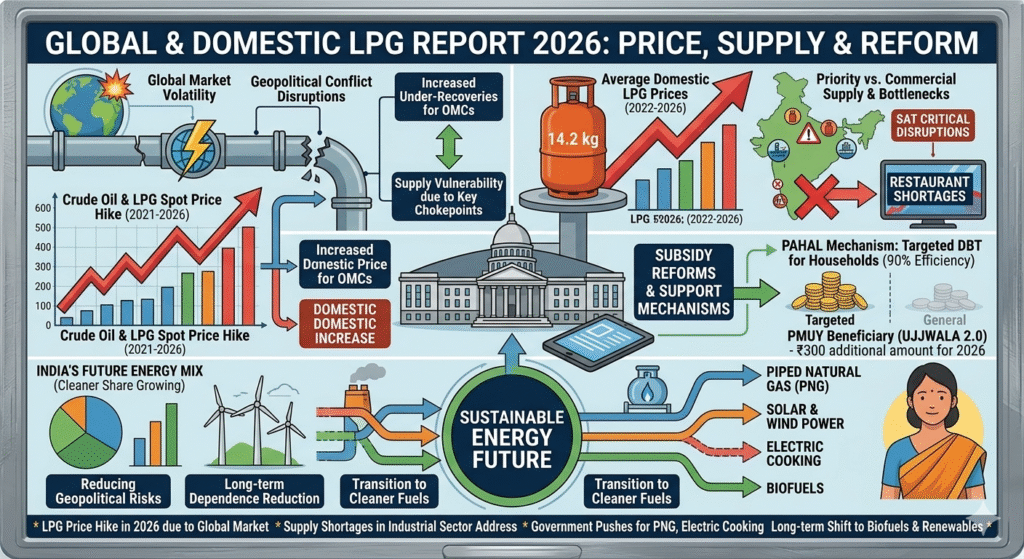
India’s LPG Gas Cylinder Crisis: How the Iran-Israel War Is Threatening 330 Million Households and a Trillion-Rupee Restaurant Industry, LPG gas cylinder shortage India
In a development that underscores just how deeply global geopolitics can reach into the heart of an Indian kitchen, millions of households and businesses across the country woke up on March 10, 2026, to find cooking gas in dangerously short supply. The trigger: an escalating military conflict between the United States, Israel, and Iran that has choked one of the world’s most critical energy corridors — the Strait of Hormuz.
Long queues snaked outside gas dealerships in Mumbai, Bengaluru, Kolkata, Hyderabad, and Chhatrapati Sambhajinagar. Restaurant owners posted shutters. Hotel kitchens went cold. The National Restaurant Association of India (NRAI) issued urgent warnings, and India’s Ministry of Petroleum and Natural Gas held emergency meetings at the highest levels of government — including a direct audience with Prime Minister Narendra Modi.
This is not a temporary inconvenience. This is a structural vulnerability laid bare: India, the world’s second-largest importer of LPG (Liquefied Petroleum Gas), imports roughly 67 per cent of its total LPG requirements — and approximately 80 to 90 per cent of those imports transit through the Strait of Hormuz, a narrow 54-kilometre-wide waterway between Iran and Oman. With that chokepoint now under threat, the country is staring at one of its most serious peacetime energy shocks in recent memory.
This article breaks down the full picture: what is happening, why it matters, who is affected, what the government is doing, and what the road ahead looks like for a nation whose 330 million LPG-dependent households were never meant to feel the tremors of a war 2,500 kilometres away.
|
31.3 MT India’s LPG Annual Consumption (FY2025) Million metric tonnes — among the highest in the world |
|
67% LPG Imported as Share of Total Demand Of which ~85–90% transits through the Strait of Hormuz |
|
60 Lakh Daily Cylinder Supply by Indian Refineries Cylinders per day at full refinery capacity (as of March 10, 2026) |
|
90% Restaurants Dependent on LPG in India Of 500,000+ restaurants represented by NRAI run on LPG cylinders |
|
₹1,200–1,300 Cr Estimated Daily Industry Loss (if crisis persists) Per day in restaurant sector losses, as per NRAI vice president |
1. The Spark: US-Israel Attack on Iran and the Hormuz Blockade
The Israel-Iran war began on February 28, 2026, when coordinated US-Israeli airstrikes targeted Iran’s nuclear facilities and military installations. Iran retaliated swiftly — not just militarily, but by doing something economists and energy analysts had long feared: leveraging its geographic control over the Strait of Hormuz.
Iran’s Islamic Revolutionary Guard Corps (IRGC) announced that the Strait of Hormuz had been shut to hostile-nation shipping and warned that vessels attempting to transit the waterway would be targeted. The Strait of Hormuz is not just an energy route — it is the world’s most critical maritime chokepoint. In 2025, roughly 13 million barrels of crude oil passed through it every single day, accounting for approximately 31 per cent of all seaborne crude flows globally. Add to that about 20 per cent of the world’s LNG exports — primarily from Qatar — and you have a corridor whose disruption can redraw the energy map of Asia overnight.
As Iranian drones struck Qatar’s Ras Laffan Industrial City and Mesaieed Industrial City — facilities critical to Qatar’s LNG production — the shock waves hit Asian energy markets instantly. India, which depends on Qatar, the UAE, and Saudi Arabia for the bulk of its LPG imports, found itself in an acutely vulnerable position.
Around 37 Indian-flagged ships carrying crude oil and LPG were reported stranded near the Strait of Hormuz as of March 10, according to industry reports. Cargoes that were due in India in March simply could not move. The supply chain that usually delivered LPG to Indian ports in 7 to 8 days from Gulf producers came to a grinding halt.
|
📌 Key Geopolitical Context The US-Israel-Iran conflict began February 28, 2026. Iran blocked the Strait of Hormuz — through which India receives 80–90% of its LPG imports. As of March 10, 37 Indian ships were stranded near the strait. Iran stated it would not target neutral commercial vessels if their countries’ territory was not used as military launch pads against Iran — offering India a diplomatic opening. |
2. India’s LPG Dependency: A Structural Vulnerability
To understand why this crisis has hit India so hard, it is essential to understand the country’s LPG supply architecture — and its inherent fragility.
2.1 How India Sources Its LPG
India consumed 31.3 million metric tonnes of LPG in the financial year 2025, making it one of the largest consumers in the world. The three state-run oil marketing companies — Indian Oil Corporation (IOCL), Bharat Petroleum Corporation Limited (BPCL), and Hindustan Petroleum Corporation Limited (HPCL) — are responsible for imports, storage, and distribution.
The country produces some LPG domestically through its refineries, but refinery output is insufficient to meet demand. The balance is covered by imports, primarily from Gulf countries: Saudi Arabia, the UAE, Kuwait, Iraq, and Qatar. These suppliers are close — cargo typically arrives within 7 to 8 days. That proximity is the same factor that makes India so exposed when the Strait of Hormuz is under threat.
2.2 The Hormuz Dependency Problem
According to Manish Sejwal, Senior Vice President at Rystad Energy, India imports roughly 67 per cent of its LPG requirements, with approximately 90 per cent of those imports transiting through the Strait of Hormuz. The Business Standard reported that around 80 to 85 per cent of India’s total LPG imports pass through this single chokepoint.
Analysts at Elara Securities estimated in a detailed report that around 69 per cent of India’s LNG imports also depend on the Strait. Among LNG terminals, Petronet LNG’s Dahej facility — India’s largest — has approximately 76 per cent dependence on Hormuz-linked supplies.
The crisis has exposed what energy security experts have warned about for years: India’s import diversification strategy has been heavily theoretical. In practice, the cost and shipping-time advantages of Gulf suppliers have meant that alternatives from the US, Brazil, or Australia have been used only at the margins.
2.3 Alternative Suppliers: Too Far, Too Slow
In a notable policy move, India signed contracts in February 2026 to import about 2.2 million tonnes per annum (MTPA) of LPG from the United States, accounting for roughly 10 per cent of total LPG imports. But the timing is not helpful in the current crisis: LPG shipments from the US take approximately 45 days to reach Indian ports. Brazil and Guyana shipments similarly take 25 to 45 days.
Compare that to 7 to 8 days from the Gulf, and the logistical problem becomes stark. Even if India places emergency orders today from alternative suppliers, those cargoes will not arrive for more than a month. The short-term crisis, therefore, must be managed through domestic measures and diplomatic channels, not import diversification alone.
|
⚠️ Shipping Time Comparison Gulf (Saudi Arabia, UAE, Kuwait, Iraq): 7–8 days | United States: ~45 days | Brazil / Guyana: 25–45 days. This is why alternative supplier diversification cannot solve the immediate crisis, even though it is the right long-term strategy. |
3. The Ground Reality: Cities in Crisis
The impact of the LPG shortage did not take weeks to materialise — it hit within days of the Strait of Hormuz disruption, and by March 10, 2026, India’s major cities were feeling the full force of the supply chain shock.
3.1 Mumbai: 8,000 Hotels Affected
Mumbai’s Hotel Owners Association (AAHAR) reported that approximately 8,000 hotels and restaurants in the city were affected by the commercial LPG shortage. About 20 per cent of those hotels had already closed, the association said. If supply did not normalise within two to three days, AAHAR warned, a further 4,000 to 5,000 establishments could shut down. Long queues of domestic consumers were reported outside gas agencies across the city, with delivery timelines for household cylinders stretching from 2 to 8 days after booking.
3.2 Bengaluru: Cold Kitchens and Black Market Prices
The Bangalore Hotels Association announced that hotel operations could be severely affected from March 10 due to the sudden halt in commercial LPG supplies. Distributors in Bengaluru said that although some had stock for four days, oil companies had stopped refilling commercial LPG cylinders — meaning even that buffer was finite. Alarmingly, some distributors were reportedly selling cylinders in the black market at up to Rs 3,000 — compared to the official commercial cylinder price of Rs 1,950.
The NRAI on X (formerly Twitter) highlighted the contradiction: the government had clarified there was no ban on commercial LPG supply, but the ground situation showed suppliers were simply unable to deliver. The gap between policy assurance and supply reality was stark.
3.3 Kolkata: Restaurants and Bakeries Under Threat
Businesses in Kolkata — particularly restaurants and bakeries that require LPG to operate — scrambled for cover on March 9, after the Ministry of Petroleum suspended the distribution of Non-Domestic Non-Exempted (NDNE) LPG cylinders. West Bengal restaurant associations warned that eateries could shut down within days if supplies were not restored.
3.4 Hyderabad: No Stock Even on the Black Market
In Hyderabad, the situation was described as critical. Most hotels and restaurants were warned they could shut operations within two days. One unnamed owner of one of the city’s oldest restaurants told Siasat.com: even if they wanted to purchase cylinders at black market prices, stock was not available. The shelves of distributors were empty.
3.5 Delhi and Punjab: Commercial Supply Stops
Delhi’s restaurants and caterers were preparing contingency plans as the conflict threatened to cut off LPG supplies. Manpreet Singh of the NRAI told PTI that supply to restaurants was drying up, and prolonged shortages or price hikes could make operations impossible. Some establishments were exploring the option of switching to electrical appliances — though industry representatives pointed out that this would raise operating costs and eliminate certain gas-dependent cooking techniques. In Punjab, oil marketing companies temporarily halted Non-Domestic Non-Exempted LPG supply, affecting commercial 19 kg, 47.5 kg and 425 kg cylinders. Distributors were also instructed not to accept refill bookings before a mandatory 25-day gap period.
4. The Human Cost: Who Is Really Affected?
4.1 India’s 330 Million Household LPG Users
LPG is not a luxury in India — it is a necessity. The government’s Pradhan Mantri Ujjwala Yojana (PMUY) scheme, which has provided subsidised LPG connections to over 100 million households from low-income backgrounds, has made cooking gas the primary fuel for the majority of Indian families. For many, particularly in rural and semi-urban areas, LPG replaced biomass and firewood, improving health outcomes and reducing indoor air pollution.
The Ministry of Petroleum and Natural Gas has prioritised domestic households in its emergency allocation framework, which means that most homeowners can still access the 14.2 kg domestic cylinder — but delivery timelines have stretched significantly, from the usual 2 to 3 days to as many as 8 days in some cities. With the mandatory inter-booking gap extended from 21 to 25 days, households are also being asked to stretch their existing supply further.
Consumers with double domestic connections — a common arrangement in middle-class households — rushed to book refills simultaneously, leading to queues and panic buying that further strained supply chains.
4.2 India’s Restaurant Industry: Rs 1,200–1,300 Crore Daily Loss
The NRAI represents over 500,000 restaurants across India. The sector generates an annual turnover of over Rs 5.7 trillion (roughly $78.9 billion) and employs over 8 million people. This is not a niche sector — it is a mass employer and a cultural institution.
Sagar Daryani, president of the NRAI, told CNBC that 90 per cent of Indian restaurants depend on LPG cylinders to run their kitchens, and that the supply disruption was creating a crisis situation that would lead to the closure of many restaurants within days if not resolved. Zorawar Kalra, restaurateur and NRAI vice-president, estimated that the industry could face losses of Rs 1,200 to 1,300 crore per day if the disruption continues.
The hospitality sector also noted that during COVID-19, restaurants had been granted essential services status by the government — enabling priority access to supplies. Industry bodies are now urging the government to extend similar status to restaurants in the current energy crisis.
4.3 Medical Institutions and Educational Facilities
The government’s emergency prioritisation framework explicitly carves out hospitals and educational institutions for non-domestic LPG supply. Hospital kitchens, medical laboratories that use LPG-based equipment, and school and college hostels are classified as priority non-domestic consumers and are being protected from the commercial supply halt. This was formalised through the Natural Gas (Supply Regulation) Order 2026, which establishes four priority sectors for gas distribution: piped natural gas for households, CNG for public transport, LPG production, and essential pipeline operations.
5. Government Response: Emergency Measures and Policy Shifts
5.1 Invoking the Essential Commodities Act
The government moved quickly to invoke the Essential Commodities Act of 1955 (ESMA), a powerful legal tool that allows the Centre to control production, supply, distribution, and trade of essential goods to prevent hoarding, price gouging, and artificial scarcity. While government sources clarified that ESMA had not been formally imposed at the consumer level — insisting stocks were adequate — the order to gas companies to strictly regulate supply and prevent black marketing was issued through this mechanism.
5.2 Priority Allocation Framework
The Ministry of Petroleum and Natural Gas issued formal orders to oil refineries to prioritise LPG production for domestic use. The sequence of priority is: domestic cooking gas for 330 million households, CNG for public transport, LPG for hospitals and educational institutions, and thereafter — if supplies allow — commercial and industrial users.
The government also set up an emergency committee with executives from IOCL, BPCL, and HPCL to review LPG allocation requests from restaurants, hotels, and other commercial establishments on a case-by-case basis.
5.3 Ramping Up Domestic Production
All Indian refineries have been directed to operate at 100 per cent capacity and to maximise LPG production. Government sources confirmed that domestic LPG production has been increased by 10 per cent since the crisis began. In combination, this means an estimated 60 lakh (6 million) cylinders are being produced domestically per day. This is a meaningful contribution — but not sufficient to replace the volume of imports that would normally flow through the Strait of Hormuz.
5.4 Diversifying Import Sources
In a significant strategic pivot, India has rerouted and diversified its import sourcing. The government confirmed that India had expanded its import of gas from non-Strait of Hormuz routes to 70 per cent, up from 55 per cent previously. India is now sourcing energy from approximately 40 countries, and Union Petroleum Minister Hardeep Singh Puri personally contacted several prospective supplier nations to strengthen emergency supply arrangements.
Additionally, India secured additional LPG and LNG supplies that do not pass through the Strait of Hormuz. A top government official stated that these supplies were expected to reach India soon, though specifics of the new suppliers were not disclosed. The government also confirmed that Indian refiners had significantly ramped up purchases of Russian oil stranded at sea — helped by a US-issued 30-day waiver (expiring April 4, 2026) allowing India to purchase sanctioned and non-sanctioned Russian oil.
5.5 The 25-Day Inter-Booking Rule
One of the more controversial emergency measures has been the extension of the mandatory inter-booking gap for domestic cylinders from 21 to 25 days. This is designed to prevent hoarding and black market diversion of subsidised domestic cylinders to commercial users — a practice that dealers warn is dangerous. However, it has also caused frustration among legitimate domestic users, particularly large families and households with high consumption needs.
The government also clarified that the price of a cooking gas cylinder would be determined based on the delivery date, not the booking date. This means cylinders booked before the recent price revision of Rs 60 per cylinder (effective March 7, 2026) but delivered after it will be charged at the new, higher rate.
|
🏛️ Key Government Actions (as of March 11, 2026) 1. Invoked Essential Commodities Act to regulate gas supply and prevent hoarding 2. Directed all refineries to operate at 100% capacity — boosting domestic LPG output by 10% 3. Prioritised domestic household supply over commercial/industrial users 4. Set up OMC committee to review commercial LPG requests case-by-case 5. Extended non-Hormuz import sourcing to 70% of total requirements 6. Extended mandatory cylinder inter-booking gap from 21 to 25 days 7. PM Modi chaired Cabinet briefing; stated war must not impact the common man 8. Secured emergency LPG/LNG supplies from non-Hormuz alternative suppliers |
6. Price Impact: How Much More Will You Pay?
6.1 The Rs 60 Hike on March 7
LPG cooking gas prices in India have increased by Rs 60 per 14.2 kg domestic cylinder, effective March 7, 2026, due to rising global energy costs. As of March 10, the price of a 14.2 kg LPG cylinder in Mumbai stands at Rs 912.50. Prices vary by state: Rajasthan (Kekri) has the lowest price in India at Rs 60 per cylinder, while Tripura (Dhalai) has the highest at Rs 1,090.50.
The global average LPG price stood at $0.78 per litre as of March 2, 2026, according to GlobalPetrolPrices.com, with significant variation across countries based on taxes and subsidies. For India, the primary cost drivers are the international benchmark LPG price and the rupee-dollar exchange rate.
6.2 Subsidies and the Ujjwala Scheme
The latest price hike primarily affects non-subsidised cylinders. Beneficiaries under the PMUY scheme continue to receive subsidies credited directly to their bank accounts through Direct Benefit Transfer (DBT). Every household in India is entitled to up to 12 subsidised cylinders per year; additional cylinders beyond this quota are charged at market price.
In Bengaluru’s commercial market, the black market price for commercial cylinders was reported at up to Rs 3,000, against an official price of Rs 1,950 — representing a 54 per cent premium driven by scarcity. The gap between official prices and street reality illustrates how quickly supply disruptions can inflate effective costs for businesses that cannot absorb delays.
6.3 What Happens If the Crisis Deepens?
Five Indian states — Assam, Tamil Nadu, Kerala, West Bengal, and Puducherry — are due to go to the polls in the first half of 2026. LPG prices and supply are perennially hot-button issues in Indian elections. Government sources have been emphatic that there is no plan for further price increases — and that ESMA has not been formally imposed. The political calculus favours keeping consumer-facing prices stable. But if Hormuz disruptions persist beyond weeks, the arithmetic of subsidy support will become increasingly difficult to sustain.
7. The Global Energy Picture: India Is Not Alone
India is the most acutely affected large economy, but the Strait of Hormuz disruption is reverberating globally.
According to energy consultancy Kpler, roughly 13 million barrels per day passed through the Strait of Hormuz in 2025 — approximately 31 per cent of all seaborne crude. Around 20 per cent of global LNG exports also transit this route, primarily from Qatar. Nomura flagged India, Thailand, South Korea, and the Philippines as the most vulnerable Asian economies to higher oil prices due to their high import dependence.
Bangladesh depends on Qatar and the UAE for 72 per cent of its LNG imports. Pakistan is almost entirely dependent on Gulf supplies for LNG, with 99 per cent of its LNG imports from Qatar and the UAE alone. China, the world’s largest crude importer, has approximately 40 per cent of its oil imports passing through Hormuz. However, Beijing has significant LNG inventory buffers (7.6 million tonnes as of end-February 2026) and access to alternative supply chains, making it more resilient to short-term disruptions than South Asian nations.
The closure of Qatar’s Ras Laffan and Mesaieed facilities — following Iranian drone strikes — has also disrupted global LNG supply. These facilities produce some of the world’s largest volumes of LNG, and their interruption has tightened the Pacific LNG basin, driving up spot cargo prices across Asia.
|
🌍 Global Context: Who Else Is Exposed? India: 67% of LPG from imports, 80–90% via Hormuz | Bangladesh: 72% of LNG from Qatar/UAE | Pakistan: 99% of LNG from Qatar/UAE | South Korea & Philippines: High import dependence flagged by Nomura | China: ~40% of oil imports via Hormuz, but better buffered with large LNG inventories |
8. The Road Ahead: Challenges and Opportunities
8.1 The Short-Term: Next 30 Days Are Critical
The government has confirmed crude stocks of approximately 25 days, and a similar inventory buffer for petrol and diesel. LPG stocks, however, are thinner given the high daily consumption and the commercial sector’s acute demand. Whether Indian households and restaurants experience continued supply pressure or gradual easing in the next 30 days will depend on three factors: whether Hormuz cargoes start moving (Iran has signalled it will not target neutral vessels from non-aggressor nations), the speed at which alternative supply routes and sources can compensate for the disrupted volumes, and the effectiveness of domestic rationing measures in prioritising household use.
8.2 The Medium-Term: Building Resilience
This crisis has made a compelling case for accelerating India’s energy security investments. The LPG supply contracts signed with the US in February 2026 (2.2 MTPA) are a step in the right direction, but shipment timelines mean these can only serve as medium-term buffer, not a crisis backstop. India needs to fast-track LPG and LNG storage infrastructure to extend its strategic buffer beyond 25 days. The government should also explore reserve-sharing agreements with allied nations and ASEAN partners — similar to the IEA’s emergency reserve protocols — to create a multilateral response capacity for future energy shocks.
8.3 The Restaurant Industry’s Pivot
In the near term, restaurants and commercial kitchens that can afford to do so are exploring contingency options: modifying menus to reduce gas-intensive dishes, switching to induction or electric cooking equipment, or exploring piped natural gas connections where available in their city’s distribution grid. These pivots are costly and imperfect, but they reflect the industry’s recognition that LPG cylinder dependence is a supply chain vulnerability — and that diversification of cooking energy sources is now a business continuity priority, not just an environmental consideration.
8.4 Policy Lessons
The LPG crisis of March 2026 will almost certainly be studied by Indian policymakers as a case study in the intersection of geopolitical risk and domestic energy security. Several lessons are already visible. First, the country’s reliance on a single maritime chokepoint — the Strait of Hormuz — for the majority of its energy imports is a systemic risk that cannot be wished away by political messaging. Second, the gap between government policy assurances (‘no shortage’) and on-the-ground supply reality (‘distributors have nothing’) creates dangerous information asymmetry that drives panic and black market behaviour. Third, the restaurant industry’s exclusion from essential services classification — when 90 per cent of establishments depend on a single, now-disrupted fuel — reveals a gap in the government’s emergency services framework. Fourth, India’s LPG storage and strategic reserve infrastructure needs urgent expansion to provide greater buffering capacity during supply shocks.
Conclusion: A Crisis That Reveals India’s Energy Achilles Heel
The LPG gas cylinder shortage that erupted across India in March 2026 is, at its heart, a story about the hidden connections between global geopolitics and everyday domestic life. A war fought between nations thousands of kilometres from India’s borders has the power to empty the gas cylinders in Mumbai kitchens, shut the stoves in Bengaluru dhabas, and leave Hyderabad’s oldest restaurants dark and silent.
India has responded with speed and pragmatism — invoking emergency laws, maximising domestic production, diversifying imports, and prioritising household supply. Prime Minister Modi’s message that war must not impact the common man reflects both political commitment and administrative urgency.
But the deeper message of this crisis is one that India must not forget when the immediate pressure eases: energy security is not just about having agreements with suppliers. It is about having the storage, the route diversification, the strategic reserves, and the domestic production capacity to absorb a shock — any shock — without it cascading into a humanitarian and economic disruption for its people.
The Strait of Hormuz will not always be closed. But the question this crisis forces India to answer — what will you do when it is? — demands a more durable and comprehensive answer than emergency committees and phone calls to prospective new suppliers.
For now, the queues outside gas agencies, the shuttered restaurants, and the empty commercial cylinders tell a story of vulnerability. The response to that story will define India’s energy future.