

Introduction: When “Pro Max” Truly Means Something
There is a certain electricity in the air whenever POCO announces a new device. The brand, born from Xiaomi’s desire to democratize flagship-grade performance, has spent years building a reputation that sits at a peculiar but powerful intersection — offering near-flagship hardware at prices that make premium smartphone buyers stop and reconsider their loyalties. With the POCO X8 Pro Max, the company has not merely taken a step forward. It has taken a giant leap, introducing a device that threatens to shake the very foundations of what consumers expect from a sub-flagship smartphone in 2026.

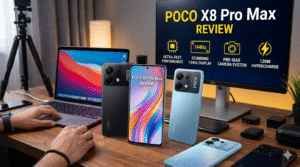
The POCO X8 Pro Max is, in every measurable sense, the most ambitious phone POCO has ever built. It arrives as the crown jewel of the new X8 series — a lineup that also includes the POCO X8 Pro — and it represents the brand’s first foray into the “Pro Max” territory, a naming convention that signals an unambiguous intention: this is not just a bigger phone. This is a more powerful, more enduring, and more complete device than anything the X-series has previously offered. From the Dimensity 9500s chipset nestled inside it to the extraordinary 8,500mAh battery that promises to outlast your busiest days, the X8 Pro Max arrives with credentials that demand serious attention.
In this comprehensive article, we will explore every dimension of the POCO X8 Pro Max — its design philosophy, display quality, processing muscle, camera capabilities, battery and charging story, software experience, connectivity suite, and ultimately its position in the competitive landscape. Whether you are a power user, a mobile gamer, a photography enthusiast, or simply someone who wants the best value for their money, this guide will give you everything you need to know about one of the most talked-about smartphones of early 2026.
The POCO Story: A Brand Built on Disruption
Before diving into the specifics of the X8 Pro Max, it is worth understanding the context in which this device was created. POCO launched in 2018 with the original POCO F1 — a phone that shocked the industry by pairing Qualcomm’s then-flagship Snapdragon 845 chipset with a price tag that most competitors reserved for mid-range hardware. It was a declaration of intent, and it worked spectacularly.
Over the following years, POCO evolved. The brand spun off as an independent entity from Xiaomi in 2020, though it continues to share resources, manufacturing expertise, and technological DNA with its parent company. The X-series specifically carved out a niche for performance-focused enthusiasts who wanted serious hardware — fast displays, powerful chips, large batteries — without the compromises that typically accompany budget pricing.
The POCO X7 Pro, which launched in early 2025, was widely considered one of the best mid-range devices of that year. It set a high bar. The X8 Pro Max does not merely try to clear that bar — it tries to vault over it entirely, introducing features and specifications that were previously the exclusive domain of ₹70,000-plus flagships.
Design and Build Quality: Premium Without Pretense
The POCO X8 Pro Max makes a strong first impression. The device sports an aluminum frame — a material upgrade over the plastic constructions found in lower-tier devices — that immediately communicates a sense of solidity and craftsmanship. The glass front and glass back complete a sandwich-style construction that feels premium to the touch without being ostentatiously luxurious.
At 8.15mm thin and weighing approximately 219 grams, the X8 Pro Max is not a featherweight device, and honestly, it does not pretend to be. The weight is largely a consequence of the massive 8,500mAh battery housed within, and once you understand that, the heft feels less like a compromise and more like a badge of honor. You are carrying power. You know it, and you feel it.
The device is available in four colors: Black, White, Blue, and an eye-catching Orange colorway that has already generated considerable buzz among design-conscious consumers. The pill-shaped camera module on the rear houses a dual-camera setup, featuring a dual LED flash for better low-light illumination — a small but meaningful differentiation from the standard X8 Pro. The overall visual identity maintains continuity with last year’s X7 Pro, preserving brand recognition while introducing subtle refinements that feel fresh.
One of the most impressive design achievements of the X8 Pro Max is its IP rating. The phone carries IP68, IP69, and IP69K certifications — a triple layer of water and dust resistance that goes beyond what many flagships offer. IP68 means it can survive immersion in up to 2 meters of water for 30 minutes. IP69K means it can withstand high-temperature, high-pressure water jets. This level of protection is virtually unheard of in this price segment and reflects POCO’s intent to make the X8 Pro Max a device that can genuinely accompany users through the demands of real life.
Display: A Visual Feast at Every Brightness Level
The display of a smartphone is its primary interface with the world, and the POCO X8 Pro Max delivers a screen that would not look out of place on a device costing twice as much.
The 6.83-inch AMOLED panel — specifically a TCL M10 OLED display — commands immediate attention. With a resolution of 1280 x 2772 pixels, it achieves a pixel density of approximately 447 pixels per inch, producing images with exceptional sharpness and clarity. Text appears razor-crisp, photos render with vivid detail, and videos — whether streaming or locally stored — benefit from a level of visual fidelity that genuinely elevates the viewing experience.
The 120Hz refresh rate ensures silky-smooth scrolling and fluid animations throughout everyday use. While it does not offer the 144Hz or variable LTPO refresh rates of some flagship competitors, 120Hz remains the gold standard for smooth mobile experiences, and in practical use, the difference between 120Hz and 144Hz is nearly imperceptible to most users.
Where the display truly distinguishes itself is in its brightness performance. The panel achieves a peak brightness of 3,500 nits — an extraordinary figure that ensures the screen remains clearly legible under direct sunlight, a challenge that many mid-range screens fail to meet. Whether you are checking maps while driving, reading outdoors, or using the camera in bright conditions, the X8 Pro Max’s display rises to every occasion.
The addition of 3,840Hz PWM dimming is a feature that deserves special recognition. PWM (Pulse Width Modulation) dimming is the mechanism by which OLED screens control brightness, and at low frequencies, it can cause eye strain and fatigue — particularly during extended nighttime use. At 3,840Hz, the X8 Pro Max’s display cycles at a frequency far too rapid for the human eye to detect, effectively eliminating flicker-induced eye fatigue. This is a feature typically associated with premium flagship panels, and its inclusion here demonstrates POCO’s commitment to genuine user wellbeing alongside raw specifications.
The screen also supports Dolby Vision, HDR10+, and HDR Vivid standards, which means that compatible streaming content on platforms like Netflix, Prime Video, and YouTube will render with expanded color ranges and superior contrast. With 68 billion colors on offer and a 90.2% screen-to-body ratio, the display occupies the front of the phone with confident authority, hemmed only by slim bezels that maximize viewing real estate.
Performance: Flagship Power in a Mid-Range Body
If there is one area where the POCO X8 Pro Max makes the most aggressive statement, it is performance. The device is powered by MediaTek’s Dimensity 9500s chipset — and the significance of this choice cannot be overstated.
The Dimensity 9500s is built on TSMC’s 3nm process node, placing it in the same manufacturing class as the chips powering today’s most expensive smartphones. The octa-core CPU configuration features a high-performance Cortex-X925 core clocked at 3.73GHz, accompanied by a cluster of Cortex-X cores and efficiency-focused Cortex-A720 cores. This architecture ensures that the processor delivers maximum single-threaded performance for demanding tasks — gaming, video editing, AI processing — while managing thermal output and battery consumption intelligently during lighter workloads.
Complementing the CPU is the Immortalis-G925 MC12 GPU, a graphics processor that represents the pinnacle of mobile graphics technology in the Dimensity lineup. The GPU is capable of delivering console-class gaming experiences, supporting ray tracing, variable rate shading, and advanced rendering techniques that push mobile gaming visuals closer to the experiences once reserved for dedicated gaming hardware.
The memory and storage configuration further solidifies the X8 Pro Max’s performance credentials. The device is available with up to 16GB of LPDDR5x Ultra RAM — the fastest mobile memory standard currently available — and up to 512GB of UFS 4.1 storage, which offers blistering read and write speeds that reduce app launch times, game loading screens, and file transfer durations to near-instant levels.
In real-world use, the combination of the Dimensity 9500s, LPDDR5x Ultra RAM, and UFS 4.1 storage translates to an experience that is uniformly fluid and responsive. Apps open instantly. Multitasking between resource-hungry applications — think video editing apps, high-fidelity mobile games, and productivity suites — occurs without hesitation. Even under sustained load, the device manages thermals effectively, avoiding the performance throttling that plagues lesser chips when pushed hard for extended periods.
For mobile gamers specifically, the X8 Pro Max is a revelation. Titles like Genshin Impact, BGMI, Call of Duty Mobile, and the latest generation of demanding Android games run at their highest graphical settings with sustained frame rates that make gameplay genuinely immersive.
Camera System: Capturing Life with Intelligence and Precision
The POCO X8 Pro Max’s camera system is built around a 50-megapixel primary sensor featuring the Light Hunter 600 image sensor — a unit designed with a particular emphasis on low-light photography. The f/1.5 aperture is one of the widest available on any smartphone at this price point, and its significance is profound: a wider aperture allows more light to reach the sensor in any given moment, which directly translates to brighter, less noisy images in challenging lighting conditions.
The primary camera is backed by Optical Image Stabilization (OIS), a mechanical system that physically compensates for hand movement during capture. OIS is essential for sharp photos in low light — where longer exposure times make shake more pronounced — and for smooth, cinema-quality video recording. The combination of the wide aperture, large sensor, and OIS creates a photography system that punches well above its weight class.
The secondary 8-megapixel ultra-wide camera extends the creative vocabulary available to users, enabling sweeping landscape captures, dramatic architectural shots, and group photos where the field of view simply cannot be compressed into a standard lens.
On the front, a 20-megapixel OV20B sensor handles selfies and video calls with impressive clarity. The wide-angle front camera ensures that group selfies and video conferencing backgrounds are captured without awkward cropping.
Video recording capabilities are comprehensive and impressive. The rear camera supports 4K recording at 30 and 60 frames per second, as well as 1080p at up to 960 frames per second for ultra-slow-motion captures. Gyro-EIS working in concert with OIS delivers footage with a smooth, gimbal-like quality. HDR10+ video recording ensures that captured footage retains wide dynamic range for premium playback on compatible displays.
Battery and Charging: The X8 Pro Max’s Most Defining Feature
If one feature defines the POCO X8 Pro Max’s identity more than any other, it is the extraordinary 8,500mAh battery. To appreciate the significance of this figure, consider that the average flagship smartphone in 2026 carries a battery in the 4,500 to 5,000mAh range. Some of the most battery-conscious devices push to 6,000 or 7,000mAh. The X8 Pro Max’s 8,500mAh capacity is not merely large — it is in a category of its own.
In practical terms, this battery translates to endurance that is genuinely transformative. A full day of heavy use — continuous gaming, video streaming, social media, navigation, and calls — ends with substantial charge remaining. For users who frequently travel, work long shifts, or simply resent the anxiety of hunting for a charging outlet, the X8 Pro Max offers something approaching peace of mind.
The 100W wired fast charging capability ensures that even when the battery does eventually need replenishment, the wait is not prohibitive. From zero to a meaningful charge takes a matter of minutes, and a full charge from empty is achievable within a timeframe that respects your schedule rather than dictating it. The addition of 27W reverse wired charging is a practical bonus — the X8 Pro Max can serve as a battery bank for other devices, charging earbuds, smartwatches, or even another phone when needed.
The combination of massive capacity and fast charging effectively eliminates battery anxiety from the ownership experience — an achievement that resonates especially strongly in markets like India, where power supply reliability varies and heavy smartphone use is the norm.
Software: HyperOS 3 and Android 16 — A Refined Experience
The POCO X8 Pro Max ships with HyperOS 3, Xiaomi’s proprietary operating system layer, built on Android 16. The combination represents the most refined software experience the brand has offered on a mid-range device to date.
HyperOS 3 introduces significant improvements over its predecessors in several key areas. The interface has been redesigned for greater clarity and visual coherence, with AI-driven personalization features that learn usage patterns and adapt accordingly. The system’s cross-device connectivity features — allowing seamless interaction between the phone, tablets, PCs, and smart home devices — have been expanded and refined, reflecting Xiaomi’s broader ecosystem ambitions.
Android 16 at the foundation brings the latest security patches, privacy controls, and performance optimizations from Google, ensuring that the X8 Pro Max is not only current at launch but benefits from the full momentum of Google’s ongoing development efforts.
The gaming mode, accessible through HyperOS 3, automatically allocates maximum resources to active games, suppresses notifications to prevent interruption, and enables performance profiles tailored to different titles. This mode works in concert with the Dimensity 9500s’s built-in gaming acceleration features to deliver a sustained high-performance experience that serious mobile gamers will appreciate.
Connectivity: Ready for a Hyper-Connected World
The POCO X8 Pro Max’s connectivity suite reflects its positioning at the top of the mid-range segment. Wi-Fi 7 support — the latest wireless networking standard — enables significantly faster wireless speeds, lower latency, and better performance in congested environments. For home networks equipped with Wi-Fi 7 routers, this translates to near-wired performance for streaming, downloading, and online gaming.
Bluetooth 5.4 ensures fast, stable wireless audio connections with the latest generation of earphones, headphones, and speakers. 5G connectivity is fully supported, while NFC enables contactless payments through Google Pay and compatible banking applications.
The inclusion of an IR blaster — a feature that has quietly disappeared from most flagship smartphones but persists thoughtfully in POCO and Xiaomi devices — transforms the X8 Pro Max into a universal remote control for televisions, air conditioners, set-top boxes, and other home appliances. It is a small feature with outsized practical value in everyday life.
Audio: Immersive Sound for Every Occasion
The POCO X8 Pro Max delivers audio through a dual stereo speaker configuration that produces a wide, room-filling soundstage. The speakers are tuned for clarity and volume, performing admirably for media consumption, video calls, and casual music listening.
For wired audio enthusiasts, the device supports Hi-Res and Hi-Res Wireless audio at 24-bit/192kHz — audiophile-grade specifications that allow the full resolution of high-quality audio files to be reproduced faithfully, revealing details in music that compressed formats simply cannot capture.
Security: Multiple Layers of Protection
The 3D ultrasonic in-display fingerprint sensor is a meaningful upgrade over the optical fingerprint sensors found in many competing devices. Ultrasonic technology reads the physical ridges of your fingerprint using sound waves rather than light, making it faster, more accurate, and capable of functioning even with wet fingers — a practical advantage that optical sensors cannot match.
Face unlock provides an additional authentication method for scenarios where speed is paramount, while the comprehensive sensor suite — accelerometer, gyroscope, proximity sensor, barometer, and compass — enables the full breadth of modern smartphone capabilities from navigation to fitness tracking to immersive gaming experiences.
Expected Pricing and Availability
The POCO X8 Pro Max is expected to launch in India on March 17, 2026, through Flipkart. Based on pre-launch information, the expected price in India is approximately ₹57,999 for the top-tier variant — positioning the device firmly in the upper mid-range segment where it competes against smartphones from Samsung, OnePlus, iQOO, and Realme.
For the global market, pricing is anticipated to follow competitive norms, with the device expected to reach European and Southeast Asian markets in the weeks following its India launch.
How the X8 Pro Max Compares: The Competitive Landscape
The POCO X8 Pro Max enters a competitive mid-range market where value expectations are higher than ever. Its primary competitors include the iQOO 15R, Samsung Galaxy A56, OnePlus 13R, and Realme GT 7.
Against the iQOO 15R, the X8 Pro Max matches on chipset performance while significantly outpacing it in battery capacity and water resistance rating. Against the Samsung Galaxy A56, the X8 Pro Max offers a more powerful processor and vastly superior battery endurance, though Samsung’s devices benefit from longer software update commitments and broader after-sales networks. Against the OnePlus 13R, the X8 Pro Max offers a larger display, greater battery capacity, and the ultrasonic fingerprint sensor advantage, while OnePlus counters with its famously clean OxygenOS experience.
In truth, no single competitor in this price segment combines the X8 Pro Max’s specific configuration of flagship chipset, massive battery, triple IP rating, Wi-Fi 7, and ultrasonic fingerprint technology. POCO has deliberately engineered a device with a differentiation story that is difficult to replicate at this price point.
Who Is the POCO X8 Pro Max For?
Understanding a device’s ideal audience is as important as cataloguing its specifications.
The X8 Pro Max is for the mobile gamer who wants to play demanding titles at maximum settings without compromise — and who wants the processing headroom to do so for hours without reaching for a charger. It is for the frequent traveler who needs a device that will remain functional through long flights, time zone changes, and days when outlets are inaccessible. It is for the busy professional who uses their phone intensively across multiple domains — productivity, communication, photography, navigation — and cannot afford the interruption of a dead battery. It is for the content consumer who appreciates a large, bright, high-quality display for streaming, reading, and browsing.
It is, frankly, for anyone who has ever felt let down by a mid-range smartphone that promised much but delivered mediocrity under sustained, real-world use. The X8 Pro Max is built to never let you down.
Potential Considerations
No device exists without trade-offs, and intellectual honesty requires acknowledging the X8 Pro Max’s limitations alongside its strengths.
The 219-gram weight, while understandable given the battery size, may be a consideration for users who prefer lighter, more compact devices. The absence of wireless charging — standard on many flagships — may disappoint some users, though the 100W wired charging speed largely mitigates the practical inconvenience. The camera system, while excellent, skips a dedicated telephoto/periscope zoom lens found on a small number of competitors, which may matter to photography enthusiasts who prioritize optical zoom versatility.
The software, while significantly improved with HyperOS 3, still includes some pre-installed applications and customizations that purist Android users may find less appealing than a cleaner alternative. These are small imperfections on an otherwise outstanding canvas.
Conclusion: A New Benchmark for What Mid-Range Can Mean
The POCO X8 Pro Max is a remarkable achievement. In a market segment where “good enough” often defines the ceiling of ambition, POCO has delivered a device that aspires to something genuinely exceptional — and, by most measures, achieves it.
The Dimensity 9500s chipset brings flagship-class processing to a price point where it has no business being. The 8,500mAh battery redefines endurance expectations for everyday devices. The 3,500-nit AMOLED display competes with screens found on phones costing significantly more. The triple IP rating, Wi-Fi 7 connectivity, ultrasonic fingerprint technology, and 100W charging combine into a feature set that would have seemed implausible in this price bracket even two years ago.
POCO has always been about disruption — about identifying where the market underserves consumers and delivering something that forces the industry to reconsider its assumptions. The X8 Pro Max is the most complete expression of that philosophy to date. It is a device that earns its “Pro Max” designation not through marketing language but through the weight of its specifications, the thoughtfulness of its engineering, and the genuine daily-use advantages it delivers to the people who carry it.
For consumers in India and globally who want serious hardware without a flagship price, the POCO X8 Pro Max is not merely a recommendation — it is the answer to a question the mid-range smartphone market has been struggling to answer for years. The question: can a phone under ₹60,000 truly have it all?
The X8 Pro Max says yes.
Quick Specifications Summary
| Feature | Specification |
|---|---|
| Display | 6.83-inch AMOLED (TCL M10), 1280×2772, 120Hz, 3,500 nits peak |
| Processor | MediaTek Dimensity 9500s (3nm TSMC) |
| CPU | Cortex-X925 @ 3.73GHz + Cortex-X4 + Cortex-A720 |
| GPU | Immortalis-G925 MC12 |
| RAM | Up to 16GB LPDDR5x Ultra |
| Storage | Up to 512GB UFS 4.1 |
| Main Camera | 50MP Light Hunter 600, f/1.5, OIS, Dual LED Flash |
| Ultra-Wide Camera | 8MP |
| Front Camera | 20MP OV20B, Wide-angle |
| Video | 4K@60fps, 1080p@960fps, Gyro-EIS + OIS, HDR10+ |
| Battery | 8,500mAh |
| Charging | 100W Wired, 27W Reverse Wired |
| OS | Android 16 with HyperOS 3 |
| 5G | Yes |
| Wi-Fi | Wi-Fi 7 |
| Bluetooth | 5.4 |
| NFC | Yes |
| IR Blaster | Yes |
| Fingerprint | 3D Ultrasonic In-Display |
| Water Resistance | IP68 / IP69 / IP69K |
| Dimensions | 8.15mm thin, ~219g |
| Colors | Black, White, Blue, Orange |
| PWM Dimming | 3,840Hz (eye-care) |
| Audio | Dual Stereo Speakers, Hi-Res 24-bit/192kHz |
| Launch Date (India) | March 17, 2026 (Flipkart) |
| Expected Price (India) | ~₹57,999 |