Did Iran Declare War on the United States? Latest Updates & Global Implications
Did Iran Declare War on the United States? The Truth Behind the Explosive Claims and Rising Global Tensions
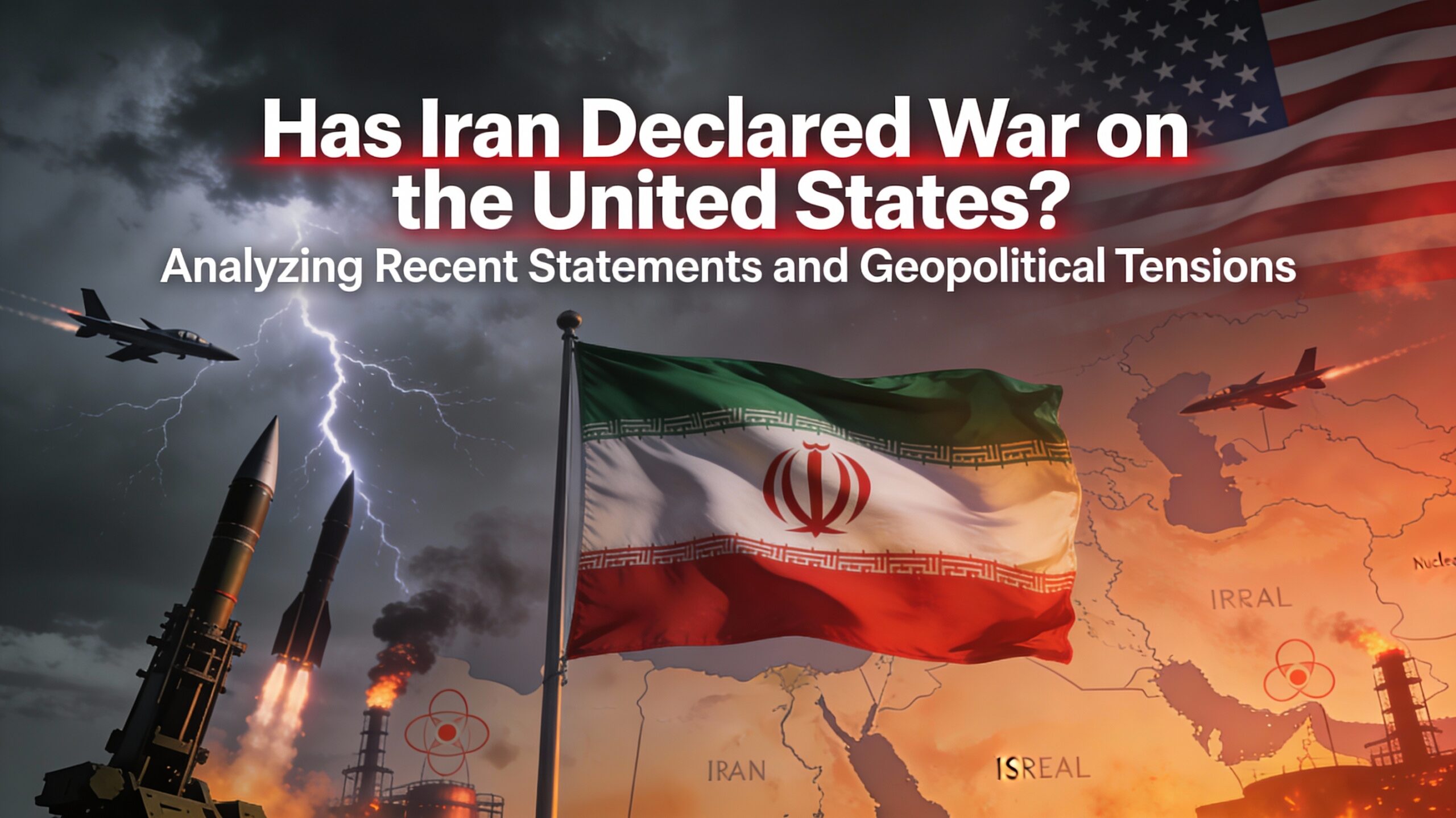
Iran declares war on United States 2025,In recent days, headlines and social media posts around the world have carried a startling claim: Iran has declared war on the United States. The words “total war,” “all-out confrontation,” and “full-scale conflict” have dominated news cycles, triggering widespread anxiety and speculation about whether the world is edging closer to another major international conflict.
The source of this global concern lies in statements made by Iranian President Masoud Pezeshkian, who publicly asserted that Iran is already engaged in what he described as a “full-scale war” with the United States, Israel, and European powers. But while the language is undeniably alarming, the reality behind it is far more complex—and far more important to understand accurately.
So, has Iran actually declared war on the United States? The clear answer is no. However, the situation is serious, layered, and unfolding within a modern geopolitical framework where wars often begin without formal announcements.
What Iran’s President Actually Said
President Pezeshkian did not issue a formal legal declaration of war. Instead, he framed Iran’s current confrontation with the West as a broad, multidimensional conflict that goes far beyond traditional battlefield fighting.
According to his statements, Iran considers itself under attack not only through military strikes but also through economic sanctions, diplomatic isolation, intelligence operations, cyber activities, and sustained political pressure. From Tehran’s perspective, these combined forces amount to a form of total war—one that is already underway.
This framing is crucial. Iranian leadership is not claiming to have launched a new war; rather, it argues that a war has been imposed upon Iran and that the country is responding to it.
Understanding the Difference Between War Rhetoric and War Declarations
In international relations, a formal declaration of war is a specific legal act. It typically involves an official announcement by a government, recognition under international law, and a clear transition into open state-to-state warfare. Such declarations were common in the early 20th century but have become extremely rare since the formation of the United Nations.
Modern conflicts—whether in Iraq, Afghanistan, Ukraine, or elsewhere—often begin without formal declarations. Governments instead rely on military “operations,” “responses,” or “defensive actions,” even when large-scale violence is involved.
Iran’s recent language falls into the category of political and strategic rhetoric, not legal war declaration. There has been no official document, parliamentary resolution, or international notification declaring war on the United States.
What Triggered This Escalation in Language?
The current rhetoric cannot be separated from the dramatic events of 2025. Earlier this year, the Middle East experienced one of its most dangerous moments in decades during a short but intense conflict between Iran and Israel.
Over roughly twelve days, the region saw airstrikes, missile launches, and significant military damage. Iranian nuclear facilities were reportedly hit, and the United States played a role in supporting Israel’s defensive and strategic operations. Although a ceasefire eventually halted direct fighting, the political and psychological impact on Iran was profound.
For Tehran, these events reinforced a long-held belief that the United States and its allies are actively working to weaken, isolate, and destabilize Iran. The subsequent re-imposition and tightening of international sanctions by European countries further deepened that perception.
Why the United States Rejects the “War” Label
Washington’s position is sharply different. U.S. officials have repeatedly stated that the United States is not at war with Iran. According to American leadership, recent military actions were defensive or preventive in nature, focused primarily on countering nuclear proliferation risks and protecting regional allies.
From the U.S. perspective, the goal is deterrence, not regime change or full-scale conflict. This difference in framing—Iran calling it war, the U.S. denying it—creates a dangerous gray zone where miscalculation becomes more likely.
History shows that many major conflicts have emerged precisely from such misunderstandings.
Why Europe Is Included in Iran’s Accusations
One of the more striking aspects of President Pezeshkian’s statements was his inclusion of European nations as part of the conflict. Iran accuses European powers of supporting U.S. policy through sanctions, diplomatic pressure, and alignment with Israel.
For years, Europe positioned itself as a potential mediator between Washington and Tehran. However, recent decisions to re-impose sanctions and back stronger measures against Iran’s nuclear program have convinced Iranian leaders that Europe is no longer neutral.
This shift has widened the conflict narrative and intensified Iran’s sense of encirclement.
The Strategic Purpose Behind Iran’s Language
Iran’s use of strong war rhetoric serves multiple purposes. Domestically, it helps rally public support during a period of severe economic hardship, inflation, and social pressure. Framing the situation as a war allows leaders to present sacrifices as acts of national resistance rather than policy failures.
Internationally, the language functions as deterrence. By declaring that Iran is already in a state of war, Tehran sends a warning that any future attack will be met with a stronger response. It is also a bargaining tactic, raising the stakes ahead of any potential negotiations on sanctions or nuclear limitations.
In modern geopolitics, words are not merely descriptive—they are strategic tools.
Why the Situation Still Matters, Even Without a Declaration
The absence of a formal declaration does not mean the danger is imaginary. Modern wars rarely begin with paperwork. They begin with incidents: a missile strike, a naval clash, a drone attack, or an assassination that triggers retaliation.
The current environment—marked by distrust, military readiness, and aggressive rhetoric—creates exactly the conditions where escalation can happen rapidly and unintentionally.
This is why analysts warn that while no war has been declared, the risk of conflict remains real.
The Role of Viral Headlines and Misinformation
Claims that “Iran has declared war on the U.S.” spread quickly because they are dramatic, alarming, and emotionally charged. However, such headlines often strip away nuance and replace understanding with fear.
Accurate reporting matters more than ever. Overstating the situation can fuel panic, while understating it can lead to complacency. The truth lies in between: Iran has not legally declared war, but it is deliberately framing the current confrontation as an existential struggle.
What Happens Next?
The path forward remains uncertain. Several outcomes are possible, including renewed diplomatic talks, further sanctions, proxy conflicts across the Middle East, or—if restraint fails—direct military escalation.
What is clear is that the language used by leaders on all sides will shape the next phase of events. History has shown repeatedly that conflicts often begin not with declarations, but with words that normalize confrontation.
Final Verdict
Iran has not formally declared war on the United States under international law. However, its leadership is openly describing the current confrontation as a total, multi-front war involving military, economic, and political dimensions. That framing is a serious warning signal to the international community.
The world is not witnessing the start of an official war—but it is watching a dangerous moment where rhetoric, mistrust, and unresolved conflicts could shape global security for years to come.