

CBSE Class 10 Session 2025–26: New Rules for Improvement and Compartment Exams — Everything You Need to know
CBSE Class 10 new rules 2025-26,
If your child is appearing for the CBSE Class 10 board exam in the 2025–26 session, there is a strong chance you have already heard whispers about “two board exams,” “new compartment rules,” and “improvement in three subjects.” But for every piece of genuine information circulating, there are five rumours causing needless confusion.
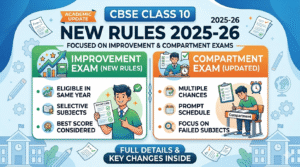

This article cuts through all of that. As someone who follows CBSE policy closely, I have compiled every significant change announced for Class 10 in the 2025–26 academic session — based on CBSE’s official notification dated June 25, 2025, and the national webinar held on November 20, 2025. Whether you are a student, a parent, or a teacher, by the time you finish reading this, you will have a crystal-clear picture of what has changed, what it means practically, and what you need to do about it.
Let us begin.
Why Did CBSE Change the Rules in the First Place?
Before diving into the specifics, it is worth understanding the “why” behind these changes. CBSE’s reforms for 2025–26 are not random administrative decisions. They are directly rooted in the National Education Policy (NEP) 2020, which India adopted as a blueprint for transforming its education system.
NEP 2020 has three core goals that are relevant here:
- Reduce examination stress by giving students more than one opportunity to demonstrate their ability
- Shift the focus from rote memorisation to conceptual understanding and application of knowledge
- Make assessment continuous and holistic, rather than dependent on a single high-stakes examination
For decades, Class 10 board results have carried enormous psychological weight. A single bad day — illness, anxiety, a family emergency — could derail an entire year of hard work. The new rules are designed to change that reality. And while the changes are significant, they are ultimately in the students’ favour — provided the students stay consistent and sincere throughout the year.
The Biggest Change: CBSE Class 10 Will Now Have Two Board Exams Per Year
This is the headline reform of the 2025–26 session, and it deserves to be understood clearly, not just in terms of dates but in terms of what it means for every student.
Starting from the academic session 2025–26, CBSE has introduced a dual examination system for Class 10. There will now be two board examinations conducted in a single academic year — one in February and one in May/June. The system is sometimes referred to as the “two-exam window” model.
The First Board Examination
- When: February 17 to March 9, 2026
- Who must appear: Every single regular Class 10 student — no exceptions
- Syllabus: Complete syllabus, identical to previous years
- Mode: Offline (paper-based), conducted at CBSE-assigned centres
- Result: Declared on April 4, 2026
This first examination is mandatory. There is no flexibility here. Regardless of whether you plan to appear for the second exam or not, you must sit for the first one. Missing three or more subjects in the first exam has serious consequences — more on that shortly.
The Second Board Examination
- When: May 15 to June 1, 2026
- Who can appear: Only eligible students (improvement or compartment categories)
- Mandatory? Absolutely not — this is entirely optional
- Result: Declared on June 6, 2026
The second examination is not a separate exam in the traditional sense. It is the same board examination — full syllabus, same rigour — but it serves a dual purpose: it functions as both an improvement exam (for students who passed but want better scores) and a compartment exam (for students who failed one or more subjects).
If a student appears in both exams, the higher score from either attempt is recorded in the final marksheet. This is a significant safety net — the second exam cannot lower your score.
Improvement Exam Rules: Who Can Appear and in How Many Subjects?
The improvement exam concept is not new to CBSE, but the rules have been significantly revised for 2025–26. Here is everything you need to know.
What Is an Improvement Exam?
An improvement exam is for students who have already passed the first board examination but are not satisfied with their scores. They want to attempt certain subjects again in the hope of doing better.
The New Rule: Maximum Three Subjects
Under the revised policy, a student who has passed the first board exam can appear in the second exam for a maximum of three subjects to improve their scores.
The subjects in which improvement is permitted are:
- Science
- Mathematics
- Social Science
- Languages (Hindi, English, or any opted language)
This was confirmed by CBSE during the national webinar on November 20, 2025, led by CBSE Chairman Rahul Singh, which was broadcast across India and abroad and attended by school principals, teachers, students, and parents.
How Does the Best Score Rule Work?
This is perhaps the most student-friendly aspect of the new policy. If you appear in both the February exam and the May improvement exam, CBSE will automatically consider the higher of the two scores for your final marksheet.
To illustrate:
- You scored 68 in Mathematics in February. You appeared for improvement in May and scored 79. Your marksheet will show 79.
- You scored 72 in Science in February. In May, you scored 65 (a bad day). Your marksheet will still show 72.
The second exam is a genuine opportunity — it cannot hurt you.
What Is NOT Allowed in Improvement?
There are clear restrictions that students must be aware of:
- You cannot improve your score in additional subjects (subjects taken over and above the compulsory five)
- You cannot add a new subject after successfully completing Class 10
- You cannot appear in stand-alone subjects under the improvement category
- No fresh registration is allowed solely for the second exam — you must have been a registered candidate for the first exam
Compartment Exam Rules: What Happens If You Fail?
The compartment exam has historically been one of the most stressful aspects of CBSE Class 10 for students and parents alike. The new system streamlines it considerably, though it also comes with strict consequences for a second failure.
Who Falls in the Compartment Category?
A student is placed in the Compartment category if they fail in one, two, or three subjects in the first board examination (February). This student is then eligible to appear in the second board exam (May) to clear those failed subjects.
This is a crucial change: the second board exam itself now serves as the compartment exam. There is no longer a separate July-August compartment sitting for the 2025–26 session in the same way as before.
What If a Student Fails the Second Exam Too?
This is where the stakes become very real. CBSE’s official notification is unambiguous on this point:
If a student who appeared under the Compartment category in the second exam (May) also fails to pass, they will be declared “Essential Repeat.” They will have to reappear in the regular February board examination of the next academic year, as a fresh candidate. No third attempt is offered within the same academic year.
This makes proper preparation for the second exam absolutely non-negotiable for students in the compartment category.
Understanding the “Essential Repeat” Category
“Essential Repeat” is a new, formally defined classification that CBSE has introduced as part of the 2025–26 reforms. If a student is declared Essential Repeat, it means they must repeat the Class 10 board examination the following year.
Who Gets Declared Essential Repeat?
A student can be placed in the Essential Repeat category under the following circumstances:
1. Absent in three or more subjects in the first exam If a student does not appear for three or more subjects in the February board exam — regardless of the reason — they are not eligible for the second exam that year. They are placed directly in Essential Repeat.
This was a specific clarification CBSE issued in a February 14, 2026 update. There had been requests from students who missed the first exam due to unavoidable reasons to be allowed directly into the second exam. CBSE declined and maintained this as a firm boundary.
2. Failing in more than three subjects in the first exam Students who fail four or more subjects in the first exam are also treated as Essential Repeat and cannot appear in the second exam.
3. Not completing Internal Assessments Under NEP 2020, internal assessment is mandatory. If a student has not completed their school-based internal assessments (projects, periodic tests, practicals), their result cannot be declared. Such students are placed in the Essential Repeat category.
4. Not meeting the 75% attendance requirement Students who do not meet the minimum attendance requirement across Classes 9 and 10 may be rendered ineligible or placed in Essential Repeat.
Why This Rule Matters
The Essential Repeat classification is CBSE’s strongest tool against the culture of “dummy schools” and coaching institute dependency. For years, some students would minimally attend school, skip internal assessments, rely entirely on coaching, and show up only for the board exam. The new rules make it structurally impossible to do that. School attendance, internal assessments, and consistent engagement are now direct prerequisites for appearing in the board exam.
Important Dates at a Glance
| Event | Date |
|---|---|
| First Board Exam (Theory) | February 17 – March 9, 2026 |
| Practical Exams (Class 10) | Before the first theory exam (Jan–Feb 2026) |
| First Exam Result | April 4, 2026 |
| Second Exam (Improvement / Compartment) | May 15 – June 1, 2026 |
| Second Exam Result | June 6, 2026 |
Important: Practical examinations will be conducted only once, before the first board exam. The same practical marks will be carried forward for the second exam as well. There is no second practical exam.
Changes in the Exam Pattern: How Will the Paper Look?
The structural reforms are not limited to the two-exam system. The question paper pattern itself has undergone a significant overhaul to align with NEP 2020’s emphasis on conceptual understanding.
New Distribution of Question Types
50% — Competency-Based Questions This is the most important shift. Half of every paper will now consist of questions that test a student’s ability to apply knowledge rather than simply recall it. These include:
- Case-based questions (a real-world scenario is described, and students answer questions based on it)
- Source-based integrated questions
- Application-based MCQs
- Data interpretation questions
20% — Objective Type (MCQs) These are straightforward multiple-choice questions designed to test analytical thinking and quick reasoning.
30% — Short and Long Answer Questions The weightage for descriptive answers has been reduced from 40% to 30%. This does not mean descriptive writing is less important — it means the balance has shifted toward testing understanding over writing ability.
Subject-Specific Changes Worth Noting
Science: The question paper has been restructured into three distinct sections — Biology (highest weightage), Chemistry, and Physics (equal weightage to each other). Each section is self-contained, allowing students to attempt them systematically.
Mathematics: The paper pattern remains unchanged from previous years. Students can still choose between Mathematics Standard (for those continuing with Maths in Class 11 and beyond) and Mathematics Basic (for those who do not plan to pursue Maths further).
Marks Distribution
| Component | Marks |
|---|---|
| Theory Examination (Board Exam) | 80 Marks |
| Internal Assessment | 20 Marks |
| Total | 100 Marks |
The passing criteria remains the same: a minimum of 33% marks in each subject is required to pass.
Internal Assessment: No Longer Optional
If there is one aspect of the new CBSE framework that students and parents tend to underestimate, it is internal assessment. Under NEP 2020, internal assessment is no longer a “formality” that schools handle on the side.
Internal assessment now encompasses:
- Periodic tests (conducted by the school)
- Projects and assignments
- Subject practicals and lab work
- Portfolio and notebook evaluations
CBSE has made it unambiguously clear: a student who does not complete internal assessments will not have their board result declared. The board has also instructed schools to follow the continuous evaluation system strictly and has warned against schools offering subjects without proper teacher infrastructure or laboratory facilities. Schools that offer subjects without CBSE’s prior approval and without qualified staff will face disciplinary action.
The message is simple: internal assessment is not just 20 marks. It is your eligibility for the board exam itself.
The New Grading Scale
CBSE has introduced a revised 9-point grading scale to replace the older model. The top 12.5% of students will receive Grade A1, with subsequent grades distributed across the rest of the performance spectrum.
The stated goal is to reduce unhealthy, rank-driven competition. Under the old system, a difference of even one mark could mean a different grade. The new system is designed to group students into broader performance bands, reducing the obsession over single-mark differences.
Registration, LOC, and Other Administrative Rules
List of Candidates (LOC)
The LOC submission deadline was September 2025. Once the LOC was submitted:
- Subject changes are not permitted under any circumstances
- The subjects chosen at LOC stage are final for both board exams
APAAR ID Requirement
Every Class 10 student must be enrolled on the Pariksha Sangam Portal and linked with their APAAR ID (Academic Bank of Credits ID). This is a new digital tracking mechanism introduced as part of NEP 2020. Overseas schools have been granted an exemption from this requirement.
No Self-Centres
CBSE has banned self-centres for Class 10 board exams in 2025–26. Students will be allotted examination centres by CBSE — they will not be examined at their own school. This is a transparency and anti-malpractice measure. Importantly, the exam centre assigned in the first exam will remain the same for the second exam as well.
Non-Refundable Fees
Both the first and second exam fees are non-refundable once submitted. Students and parents should factor this into their planning.
Special Provisions for Specific Student Categories
CBSE has ensured that the new system does not disadvantage students with genuine scheduling conflicts:
- Sports students representing India or their state at national and international levels are permitted to appear in either the first or the second exam — they are not penalised for missing one due to a tournament
- Students from winter-bound schools (schools in cold regions that follow different academic calendars) have been given scheduling flexibility
- CWSN (Children with Special Needs) students also have exam scheduling flexibility under the revised framework
Class 11 Admission: What Happens While Awaiting the Second Exam Result?
This is one of the most practically important questions for families. If a student’s first exam result is a compartment, or if they wish to appear for improvement, does that mean they cannot start Class 11 until June?
CBSE has addressed this: students who have not yet cleared all subjects after the first exam can take provisional admission to Class 11. This provisional admission will be confirmed once the second exam result is declared in June 2026. Schools are expected to facilitate this seamlessly.
Re-Evaluation and Photocopy: When Can You Apply?
One more administrative change worth noting: photocopy requests, verification, and re-evaluation services will only be available after the second board exam results are declared (i.e., after June 2026).
After the first exam result in April, these services will not be open. The rationale is straightforward — if a student is dissatisfied with their marks, they have the option of appearing in the improvement exam. The re-evaluation window opens only once the entire dual-exam process is complete.
Frequently Asked Questions
Q: Is it compulsory to appear in both exams? No. Only the first exam (February) is compulsory. The second exam (May) is optional — only for those who qualify for improvement or compartment categories.
Q: Does the second exam cover a reduced syllabus? No. Both exams cover the complete syllabus. The second exam is not easier or shorter.
Q: What if I do worse in the second exam than the first? The best score from either attempt is automatically considered. A lower score in the second exam will not affect your result.
Q: Can I skip the first exam and only give the second? No. If you are absent in three or more subjects in the first exam, you will be placed in Essential Repeat and will not be allowed to sit for the second exam that year.
Q: Can I add a new subject in the second exam? No. Subject changes are not permitted after the LOC submission. No new subjects can be added.
Q: When will the merit certificate be issued? Merit certificates will be issued after the second exam results are declared in June 2026.
Q: What if I fail in four or more subjects in the first exam? You will be categorised as Essential Repeat and will have to reappear in the February board examination the following year.
Q: Does the Class 12 board exam also follow the two-exam system? No. As of now, the dual exam system applies only to Class 10. Class 12 continues with the single exam format.
Summary: Old Rules vs New Rules
| Aspect | Old System | New System (2025–26) |
|---|---|---|
| Board exams per year | 1 | 2 (February + May) |
| Improvement subjects allowed | Up to 2 | Up to 3 |
| Compartment attempt | Separate July–August exam | Second board exam (May) |
| Best score policy | Not applicable | Best of two attempts recorded |
| Essential Repeat | Less formally defined | Clearly defined (absent/fail in 3+) |
| Internal assessment | Important but flexible | Mandatory — non-completion = ineligible |
| Attendance requirement | 75% rule existed | 75% strictly enforced |
| Self-centres | Permitted | Banned |
| Re-evaluation availability | After main exam result | Only after second exam result (June) |
Final Thoughts: Is This New System Good for Students?
Honestly — yes, but only for those who engage sincerely with their education.
For a diligent student, the dual exam system is a genuine gift. One bad day in February does not define your academic year. You have a structured, legitimate second chance in May. Your best performance is the one that counts. For compartment students, the integration of the compartment exam into the second board exam removes the waiting period and psychological trauma of a separate exam season.
However, the system is deliberately unforgiving of disengagement. If you skip school, neglect internal assessments, or treat the first exam carelessly — the rules close their doors firmly. Essential Repeat is a real consequence, not just a paper category.
The underlying message of CBSE’s 2025–26 reforms is this: education is a year-round process, not a month-long sprint. Students who internalise that message will find the new system working entirely in their favour.
If you are a Class 10 student reading this — do not let the existence of a second exam lull you into complacency. Treat the February examination as your primary, full-effort attempt. The May exam is a bonus, not a backup plan.
Study consistently, attend school regularly, complete your internal assessments, and walk into the board exam prepared. The new system rewards exactly that kind of student.
📌 Disclaimer: The information in this article is based on CBSE’s official notification dated June 25, 2025, the February 14, 2026 update, and publicly available CBSE communications. For the most current and authoritative information, always refer to CBSE’s official website: cbse.gov.in
Found this article helpful? Share it with other Class 10 students and parents. If you have a specific question not covered here, drop it in the comments — we will do our best to answer it.
Suggested Internal Links (for WordPress Editor)
- CBSE Class 10 Syllabus 2025–26 — Subject-wise PDF Download
- CBSE 10th Sample Papers 2026 — All Subjects with Answer Keys
- What Is NEP 2020? A Simple Explainer for Parents and Students
- CBSE vs State Board: Key Differences Explained
- Career Options After Class 10: A Comprehensive Guide