

UGC Rules Explained: Meaning, Objectives, Regulations, and Their Real Impact on Indian Higher Education
Introduction: Why UGC Rules Matter More Than We Think
Every year in India, lakhs of students stand at the same crossroads. A Class 12 student wonders, “Is this university genuine?” A parent asks, “Will this degree be valid for government jobs?” A teacher worries, “Will my promotion be approved under UGC norms?”


Behind all these questions lies one powerful but often misunderstood body — the University Grants Commission (UGC).
For many, UGC rules sound like boring government regulations written in complex language. But in reality, these rules quietly shape the future of students, control the quality of colleges, decide teachers’ careers, and protect families from fake universities and invalid degrees.
This article explains UGC rules in simple, human language — not as dry law, but as a system that directly affects real lives in Indian higher education.
What is UGC?
Full Form of UGC
UGC stands for University Grants Commission.
When and Why Was UGC Established?
The University Grants Commission was established in 1956 under the UGC Act, 1956 by the Government of India.
At the time of Independence, India had very few universities. There was:
-
No uniform standard of education
-
No proper system to fund universities
-
No authority to check fake or poor-quality institutions
UGC was created to:
-
Maintain standards of higher education
-
Coordinate between universities and the government
-
Distribute grants and funding
-
Protect the interests of students and teachers
Is UGC a Teaching Body?
No.
UGC does not run colleges or universities. It is a regulatory and funding body.
Role and Powers of UGC
UGC acts like a quality controller of higher education. Its main powers include:
-
Recognising universities
-
Framing regulations for degrees
-
Approving courses and institutions
-
Disbursing government grants
-
Maintaining academic standards
-
Taking action against fake universities
Without UGC recognition, a university’s degree may be legally invalid.
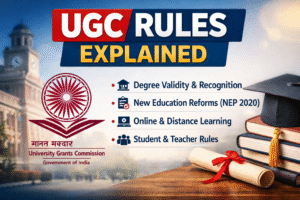

Difference Between UGC and Other Bodies
Many people confuse UGC with other councils. Let’s clear that up.
| Body | Role |
|---|---|
| UGC | Overall regulation of universities |
| AICTE | Technical education (engineering, MBA, etc.) |
| NCTE | Teacher education (B.Ed, D.El.Ed) |
| BCI | Law education |
| MCI/NMC | Medical education |
👉 A university must be UGC-recognised, even if courses are approved by AICTE or others.
Objectives of UGC Rules
UGC rules are not made randomly. Their main objectives are:
1. Maintaining Quality of Education
UGC ensures that:
-
Courses meet minimum academic standards
-
Faculty are qualified
-
Infrastructure is adequate
2. Uniformity Across India
A degree from a university in Kerala should have equal value as one from Delhi or Rajasthan.
3. Protecting Students
UGC rules prevent:
-
Fake universities
-
Invalid degrees
-
Exploitation by private institutions
4. Supporting Teachers
UGC defines:
-
Minimum qualifications
-
Pay scales
-
Promotion criteria
5. Proper Use of Public Funds
UGC ensures government grants are used fairly and transparently.
Recognition of Universities Under UGC Rules
Types of Universities Recognised by UGC
UGC recognises only specific categories:
-
Central Universities
Established by an Act of Parliament
Example: Delhi University, JNU -
State Universities
Established by State Legislature
Example: Lucknow University, Rajasthan University -
Deemed-to-be Universities
Given special status for excellence
Example: VIT, Manipal University -
Private Universities
Established by State Acts but must follow UGC norms
⚠️ Any institution outside these categories cannot legally award degrees.
Fake Universities: A Serious Problem
Every year, UGC publishes a list of fake universities.
These institutions:
-
Use words like “International”, “Global”, or “National”
-
Operate without legal authority
-
Issue invalid degrees
💔 Students often realise the truth after graduation, when jobs or higher studies are denied.
UGC Rule:
👉 Degrees from unrecognised universities are not valid for jobs, exams, or further education.
UGC Rules on Degree Validity
A degree is valid only if:
-
Issued by a UGC-recognised university
-
Course is approved
-
Mode of study is permitted (Regular/ODL/Online)
UGC does not recognise:
-
Degrees from franchises
-
Study centres of unapproved universities
-
Backdated or shortcut degrees
Choice Based Credit System (CBCS)
What is CBCS?
CBCS allows students to:
-
Choose subjects across disciplines
-
Earn credits
-
Learn at their own pace
Why CBCS Was Introduced
Earlier, education was rigid. CBCS brings:
-
Flexibility
-
Interdisciplinary learning
-
Global compatibility
Example:
A BA student can take a psychology elective.
An engineering student can study economics.
Academic Bank of Credits (ABC)
What is ABC?
ABC is a digital credit bank where:
-
Student credits are stored
-
Credits can be transferred between institutions
Why ABC Matters
-
Supports multiple entry–exit
-
Helps dropouts return later
-
Makes education flexible
Multiple Entry and Exit System (NEP 2020)
UGC implemented this under NEP 2020.
| Exit Stage | Qualification |
|---|---|
| After 1 year | Certificate |
| After 2 years | Diploma |
| After 3 years | Bachelor’s Degree |
| After 4 years | Bachelor’s Degree with Research |
This helps students who:
-
Face financial problems
-
Need to pause education
-
Want skill-based exits
UGC Rules for Colleges
Affiliated Colleges
-
Follow university syllabus
-
No independent degree power
Autonomous Colleges
-
Design own syllabus
-
Conduct exams
-
Degree awarded by parent university
NAAC Accreditation
UGC strongly encourages NAAC accreditation for:
-
Funding
-
Autonomy
-
Quality assurance
UGC Rules for Teachers and Faculty
This is one of the most sensitive areas.
Minimum Qualifications
-
Master’s degree with minimum percentage
-
NET qualification mandatory (with exceptions)
-
PhD as per UGC norms
Recruitment Rules
UGC prescribes:
-
Advertisement procedure
-
Selection committee composition
-
Merit-based appointments
Promotion Under CAS
Career Advancement Scheme (CAS) defines:
-
API scores
-
Research publications
-
Teaching experience
Many teachers feel pressure, but UGC aims to:
-
Promote merit
-
Encourage research
-
Improve teaching standards
UGC Pay Scales
UGC regulates:
-
Assistant Professor
-
Associate Professor
-
Professor pay scales
These are implemented by:
-
Central Universities
-
State Universities (with state approval)
UGC Rules for Students
Migration and Transfer
-
Allowed with proper documentation
-
Credit transfer via ABC
Attendance Rules
-
Universities may mandate minimum attendance
-
Flexibility exists but discipline is required
Grievance Redressal
UGC mandates:
-
Grievance cells in universities
-
Online complaint portals
-
Anti-ragging mechanisms
Distance Education and Online Learning Rules
Open and Distance Learning (ODL)
UGC allows ODL only if:
-
University is approved
-
Courses are permitted
-
Study centres are authorised
Online Degrees
UGC now allows:
-
Fully online degrees
-
Only from top-ranked universities
-
With strict monitoring
⚠️ Not all online degrees are valid — UGC approval is compulsory.
Foreign Universities in India
Under new UGC regulations:
-
Foreign universities can open campuses in India
-
Must follow Indian laws
-
Degrees must meet UGC standards
This aims to:
-
Reduce brain drain
-
Improve global exposure
Myths vs Reality About UGC Rules
Myth 1: UGC controls everything
❌ Reality: Universities still have autonomy
Myth 2: Private universities are fake
❌ Reality: Many are valid if UGC-recognised
Myth 3: Online degrees are useless
❌ Reality: Approved online degrees are valid
Criticism and Challenges of UGC Rules
No system is perfect.
Common Criticisms
-
Over-regulation
-
Delay in approvals
-
Pressure on teachers
-
One-size-fits-all approach
Ground Reality
-
Rural colleges struggle with infrastructure
-
Teachers face workload pressure
-
Students face confusion due to frequent changes
UGC is evolving, but reforms are ongoing.
Real-Life Case Studies
Case 1: Student from Fake University
A student spent 3 years and money on a fake university degree — later rejected by UPSC.
Case 2: College Losing Recognition
A private college lost approval due to poor faculty and infrastructure.
Case 3: Teacher Promotion Delay
CAS delays caused frustration, but improved transparency later helped.
Future of UGC Rules in India
UGC is moving towards:
-
Digital systems
-
Flexibility
-
Global standards
-
Skill-based education
With NEP 2020, the future looks:
-
More student-centric
-
More multidisciplinary
-
More adaptable
Conclusion: Why Understanding UGC Rules Is Essential
UGC rules are not just government paperwork. They are guardrails that:
-
Protect students from fraud
-
Maintain academic standards
-
Shape careers of teachers
-
Build trust in Indian education
For students, parents, teachers, and institutions — knowing UGC rules is not optional anymore, it’s essential.
Education is a lifelong investment. And UGC rules ensure that investment is safe, valuable, and meaningful.