

UConn Basketball 2025: Why the Huskies Are National Title Contenders – Health, Depth & MSG Magic
UConn basketball 2025,UConn men’s basketball enters the heart of the 2025-26 season looking every bit like a program built to live in the national-title conversation, not just visit it for a year or two. With an elite ranking, a deep and balanced roster, and another marquee stage at Madison Square Garden, the Huskies once again feel like the team nobody wants to see in March.
Current snapshot: a true contender
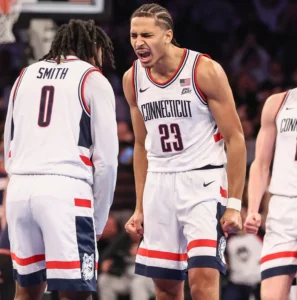
UConn sits near the top of the national rankings and projects as a high NCAA Tournament seed, backed by an 8–1 start and a strong overall metrics profile. The Huskies already own a marquee neutral-site win over Illinois at Madison Square Garden, with their only loss coming in a tight, competitive game against Arizona in Storrs.
The NCAA’s NET rankings, which weigh efficiency, game location, and strength of schedule, place UConn firmly in the top 10, underscoring the strength of both their resume and underlying performance. Within the Big East, the Huskies are positioned as one of the league’s standard-bearers and a favorite to sit at or near the top of the conference standings once play gets fully underway.
Dan Hurley’s culture and identity
By year eight, Dan Hurley has built UConn into a program with a clear identity: tough, defensively committed, and relentless in how it attacks the glass and the paint. The Huskies under Hurley rarely beat themselves, play with edge, and treat every neutral-floor or high-profile game as a statement opportunity, which is why their performances in venues like Madison Square Garden carry extra weight.
Hurley’s record in “big game” environments speaks volumes; he owns a strong winning mark at Madison Square Garden, including an impressive record in non-conference regular-season contests there. That big-stage familiarity filters down to the players, who carry themselves less like a team chasing validation and more like one defending an established standard.
Roster depth and rotation strength
What separates this UConn group from many talented teams is the sheer quality and flexibility of its depth. The Huskies can play big or small, defensive-minded or uptempo, without a dramatic drop-off when they go to the bench, thanks to a rotation constructed through a mix of prep recruiting, development, and portal additions.
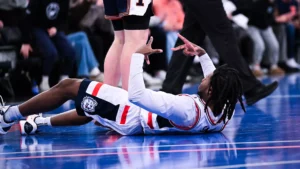
Across the depth chart, UConn has reliable contributors at every spot: multiple capable ball-handlers, versatile wings who can guard up or down, and a frontcourt that rebounds at a level capable of tilting games. That balance means Hurley can ride the hot hand on a given night or adjust quickly if foul trouble, matchups, or injuries force changes.
Health, continuity, and chemistry
One quiet advantage for UConn this season has been relative stability and health across its core contributors, especially compared to programs that underwent heavy offseason turnover. Several key Huskies returned instead of testing professional waters or the transfer portal, giving the team continuity in its system and leadership.
That year-over-year continuity shows in the way UConn executes late-clock sets, communicates defensively, and handles pressure in tight games. Players know where shots will come from, where help is arriving on defense, and how Hurley likes to manage game flow, giving them a composure that often separates contenders from hopefuls in February and March.
Defense, rebounding, and physicality
UConn’s defense continues to be the foundation of its national-title ambitions. The Huskies pressure the ball, contest threes, and funnel drivers into length and physical bodies inside, forcing opponents into difficult, low-efficiency looks over the course of 40 minutes.
On the glass, UConn imposes itself in ways that don’t always show up in highlight reels but decide games: second-chance points, long rebounds after tough defensive stands, and the ability to close possessions cleanly. In early-season action, including a dominant rebounding performance against New Haven, UConn’s margin on the boards has been a clear, repeatable edge.
Efficient, balanced offense
Offensively, UConn has the profile coaches envy in March: multiple scoring options, unselfish ball movement, and enough shooting to punish help defense. Different players can carry the scoring load on different nights, which makes it difficult for opponents to design a game plan around stopping a single star.
The Huskies’ offensive efficiency is boosted by their willingness to play inside-out, generating paint touches and then spraying the ball to shooters when defenses collapse. That approach, paired with their offensive rebounding, ensures that even on nights when the jumper isn’t falling, they can manufacture points at the foul line and around the rim.
Big East gauntlet and schedule strength
If UConn cuts net in April, its path will have been forged through one of the toughest schedules in college basketball. The Huskies face a brutal non-conference slate, including multiple preseason top-25 opponents and high-profile neutral-site games that test their composure and versatility.
Once Big East play fully kicks in, UConn will grind through a league that routinely produces tournament-caliber teams and hostile road environments. For the selection committee, that combination of a demanding non-conference schedule and a rugged conference run is exactly the kind of profile that earns a top seed and a favorable path.
UConn schedule snapshot
| Aspect | Detail |
|---|---|
| Overall record | 8–1, including a neutral-site win over Illinois and a close loss to Arizona |
| Non-conference slate | Multiple preseason top-25 opponents and high-profile neutral games |
| Big East outlook | Projected to sit among conference leaders with strong metric profile |
Madison Square Garden moment
Madison Square Garden has essentially become a second home for UConn basketball, and this season adds another chapter with the Jimmy V Classic matchup against Florida. That game doubles as both a high-stakes NET opportunity and an emotional chance to avenge last season’s NCAA Tournament loss to the Gators.
Hurley’s strong track record at “The World’s Most Famous Arena” adds extra intrigue, as UConn has consistently delivered big performances under the MSG lights. A convincing showing there not only boosts the Huskies’ resume but also reinforces the idea that they are built to thrive on the sport’s biggest stages.
NET rankings and tournament positioning
In the first release of the NCAA NET rankings, UConn checked in around the top eight nationally, a sign of how well their performance, schedule, and efficiency metrics stack up against the field. The NET, which replaced the old RPI system, puts heavy emphasis on beating quality teams and performing well away from home, areas where the Huskies have already distinguished themselves.
Every high-level neutral-site game—especially at places like Madison Square Garden—acts as a swing factor in those rankings, and UConn is positioned to gain even more ground with strong December and conference results. That sets the stage for a potential top-two seed scenario, which historically correlates strongly with deep runs into the second weekend and beyond.
Why this team feels built for March
Put simply, this UConn team checks the boxes coaches and analysts associate with true national-title threats: elite metrics, depth, defensive backbone, and big-game seasoning. They have already proved they can beat high-level opponents away from home, respond to adversity, and lean on a system rather than hoping one hot shooter can carry them.
As the 2025-26 season unfolds, the Huskies will still face tests—road trips in the Big East, potential injuries, shooting slumps—but their floor feels higher than most contenders’. If UConn stays healthy and continues to grow into its identity, the program will not just be chasing another March moment; it will be chasing another banner, with all the confidence of a team that has been here before and expects to be here again.