


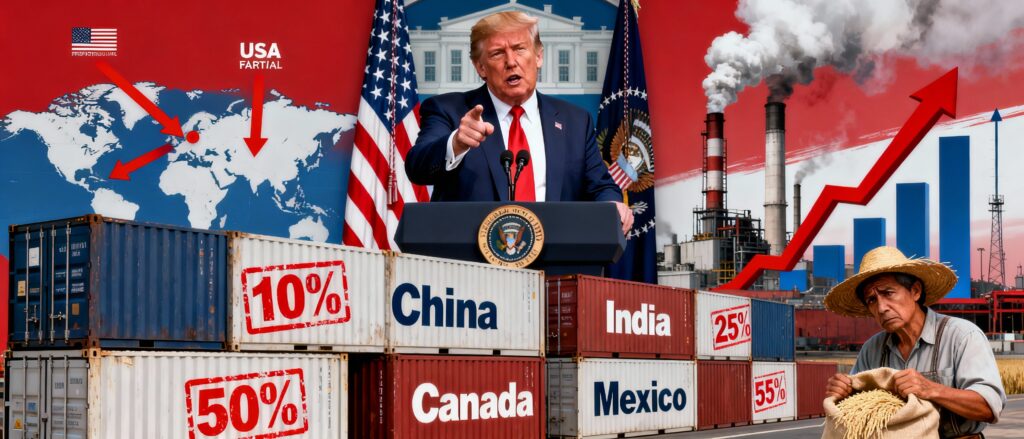
Trump Tariffs 2025: New Developments, Global Impact, and What the World Should Expect Next
President Donald Trump’s 2025 tariff agenda has dramatically altered the global trade environment. Since returning to the White House in January, Trump has rolled out a sweeping set of duties—including a flat 10% tariff on all imports and significantly higher rates on major trading partners such as China, India, Canada, Mexico, and the European Union. His administration argues these actions are necessary to rebalance long-standing trade deficits, strengthen domestic industries, and pressure foreign governments into “fairer” agreements.
But the aggressive tariff wave has also fueled global retaliation, rising consumer prices, supply-chain disruptions, and market volatility. By December 2025, Trump had intensified threats, targeting new tariffs on Indian rice and Canadian fertilizer, even as trade negotiations continued behind closed doors.
2025 Tariff Timeline: Key Events and Escalations
Trump’s second term began with rapid policy action. A national emergency declaration in April allowed him to use IEEPA powers to impose broad import taxes. Major milestones in the tariff rollout include:
February 4, 2025
-
10% tariffs on all Chinese imports
-
25% duties on goods from Canada and Mexico (energy limited to 10%)
March 3–4, 2025
-
China tariffs rise to 20%
-
Canada and Mexico duties reaffirmed with specific exemptions under USMCA
April 5–9, 2025: “Liberation Day”
-
Universal 10% baseline tariff goes into effect
-
Steep targeted tariffs:
-
34% on China
-
27% on India
-
20% on the EU
-
Up to 46% on Vietnam
-
June–July 2025
-
High-pressure trade negotiations with a deadline of August 1
-
Temporary pauses on auto tariffs for Canada and Mexico
August 7, 2025
-
50% tariffs on Indian goods due to India’s ties with Russia
-
All US–India trade talks halted
December 2025
-
New threats against Indian rice and Canadian fertilizer
-
Announcement of a $12 billion aid package for US farmers, funded by tariff revenue
This staged approach follows Trump’s “reciprocity doctrine”—raising or lowering tariffs based on how other nations respond to US demands.
Trump’s Justification: The ‘America First’ Economic Doctrine
Trump frames tariffs as essential tools to correct what he sees as decades of one-sided trade practices. In his view, partners like China and India maintain strict barriers against American exports while flooding the US with cheaper goods. He claims tariffs create leverage, generate revenue, and ultimately bring manufacturing back home.
In a December White House address, Trump argued that foreign suppliers—especially Indian companies dominating certain rice brands in US stores—are hurting American farmers. His message was simple:
“Tariffs fix the problem in minutes.”
He insists that higher import duties:
-
Encourage domestic production
-
Reduce reliance on foreign markets
-
Fund farm relief without increasing taxes
-
Lead to “long-term price stability”
Critics, however, point out that many outcomes mirror the disruptions of the 2018–2019 trade war, with broader global consequences this time around.
Economic Impact on the United States
Independent economic studies paint a mixed—and often negative—picture of the tariff strategy.
Major Findings
-
Wharton School projections:
-
8% decline in GDP in the long run
-
7% drop in average wages
-
Middle-income households may lose $58,000 in lifetime earnings
-
-
Yale Budget Lab analysis:
-
Slower GDP growth (down 0.5% in 2025–26)
-
505,000 fewer jobs
-
A permanently smaller economy by roughly $125 billion per year
-
-
Goldman Sachs research:
-
US consumers pay 55% of tariff costs through higher prices on vehicles, electronics, household goods, and imported food
-
Sectoral Effects
-
Consumers: Higher costs for cars, groceries, electronics, and fast-moving retail items from platforms like Temu and Shein
-
Farmers: Reduced export demand, higher fertilizer costs, and heavy reliance on government support
-
Manufacturing: Some gains in steel and metals, but widespread price pressure and investment uncertainty
-
Financial markets: Weaker dollar, rising borrowing costs, and shaken investor confidence
Overall, analysts say tariffs act as a “hidden tax” on American households while offering uncertain long-term benefits.
Global Response and Intensifying Trade Clashes
Countries worldwide have responded with their own countermeasures:
China
-
Up to 125% retaliatory duties (some paused)
-
Export restrictions on rare earth elements
-
Bans on several US agricultural imports
-
Increased sourcing from Canada and South America
India
-
Hit with 50% US tariffs in August
-
Preparing WTO complaints over farm subsidies and tariff hikes
-
Bilateral ties strained despite diplomatic outreach earlier in the year
Canada and Mexico
-
Negotiated temporary relief for autos under USMCA
-
Still face stiff duties on metals and select agricultural goods
EU, Japan, South Korea, Vietnam
-
Imposed matching or near-matching tariff rates
-
Strengthening regional supply-chain alliances to reduce dependence on the US
Collectively, these actions signal a re-emergence of global protectionism and a weakening of WTO rule-based trade norms.
Spotlight: The India Rice Tariff Threat
One of the most contentious developments in December 2025 is Trump’s warning of higher tariffs on Indian rice, especially varieties dominating US supermarket shelves.
He argues that:
-
Cheaper Indian rice is undercutting southern US farmers
-
Imports have surged beyond “fair market limits”
-
Tariffs are needed to “restore balance”
India, already facing 50% duties on many exports, sees this as political pressure rather than an economic dispute. Any tariffs on rice could spark:
-
Higher prices for US consumers
-
New retaliation from India
-
Suspension of ongoing trade dialogues
This issue is particularly relevant for Indian news outlets, trade analysts, and content creators covering US–India relations.
Impact on Businesses and the Global Consumer
Tariffs have disrupted supply chains across sectors:
-
Companies reroute production to Southeast Asia or Latin America
-
Costs increase for everyday essentials—food, electronics, apparel
-
Coffee, bananas, and similar products become more expensive due to limited US alternatives
-
Importers face unpredictable policy swings and compliance challenges
US farmers receive significant government support, but economists warn these bailouts are temporary fixes rather than sustainable solutions.
For global consumers, tariffs mean:
-
Higher prices
-
Slower economic growth
-
Reduced availability of certain imported goods
Looking Ahead: Will 2026 Bring Negotiation or More Turbulence?
The outlook for US trade policy remains uncertain. Key possibilities include:
1. More Escalation
Trump may introduce new tariffs on:
-
Indian agricultural products
-
European vehicles
-
Chinese electronics
-
Canadian fertilizers and grains
2. Negotiated Settlements
Some progress was made with China during the Geneva framework discussions. Similar talks with India and the EU could resume if conditions improve.
3. Continued Economic Pressure
Even with deals, many economists believe the US will experience:
-
Lower productivity
-
Higher inflation
-
Sluggish investment
-
Persistent market volatility
Analysts warn that the current tariff wave amounts to one of the most significant tax increases—direct or indirect—in modern US history.
Conclusion
Trump’s 2025 tariff campaign has reshaped global trade in ways the world hasn’t seen in decades. While the administration claims these policies will revive American industry and strengthen the domestic economy, evidence suggests widespread disruption, higher prices, strained international relations, and long-term economic costs.