


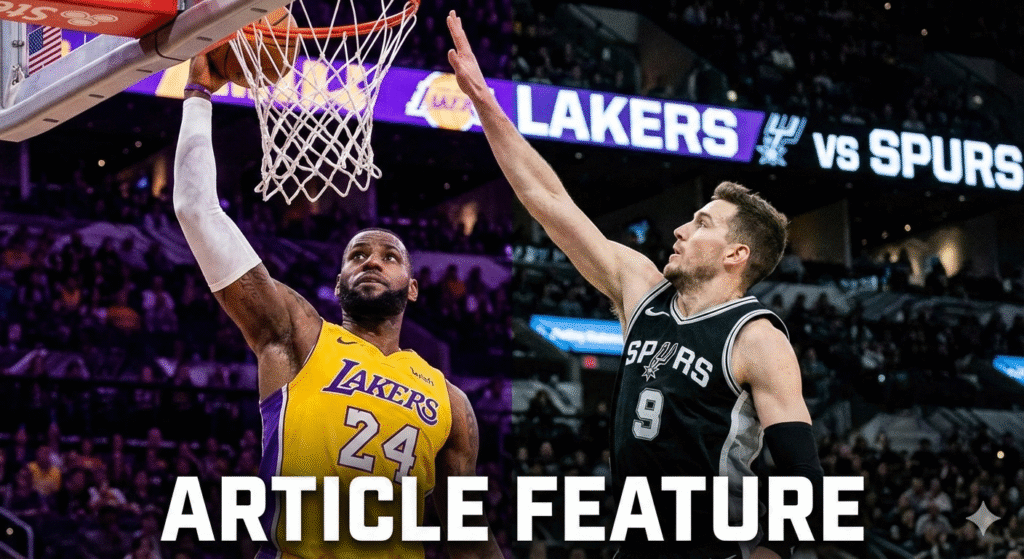
Lakers vs Spurs: LeBron’s Absence, Wembanyama’s Rise & NBA Shift
I. The Night the Streak Ended
The announcement came quietly, almost clinically — a pregame injury report update pushed to phones across the basketball world. LeBron James: out. Left foot.
In another era, it might have been just another line in the transactional churn of an 82-game season. But this wasn’t just another absence. This was the kind of notification that made fans pause mid-scroll. The kind that made talk shows reset their rundowns and made former players text each other with a simple, stunned: “Wow.”
For more than two decades, LeBron James has been the NBA’s most constant variable. Seasons changed, teammates rotated, arenas renamed, but LeBron remained — durable, dominant, defiantly present. His All-NBA streak, stretching across 21 seasons, was less a statistical accomplishment than a symbol of sustained excellence in a league that devours time.
And now, on a night the Los Angeles Lakers were set to face the San Antonio Spurs, that streak was in jeopardy.
Inside Crypto.com Arena, the mood felt different. There was no dramatic announcement, no farewell ceremony. Just a murmur in the stands as fans processed what it meant. For a generation raised on LeBron — from his high school anointment to Miami’s heat, Cleveland’s redemption, and Los Angeles’ banner-raising glory — this felt like a tremor.
But it was fitting, in its own poetic way, that the opponent was San Antonio.
Because Lakers vs. Spurs has never been just a regular-season game. It’s a chapter in a larger story — of dynasties colliding, of superstars measured against each other, of eras overlapping and then yielding. Kobe vs. Duncan. Shaq vs. Robinson. Popovich vs. Phil Jackson. Now, LeBron vs. Wembanyama.
This matchup, especially in this season, isn’t just about wins and losses. It’s about legacy and transition. About resilience. About what basketball looks like when yesterday’s giants share the floor — or the injury report — with tomorrow’s.
II. A Tale of Two Franchises
The Los Angeles Lakers: History as a Burden and a Standard
The Lakers don’t rebuild. They reload. Or at least, that’s the mythology.
Seventeen championships. Showtime. The Mamba. Purple and gold woven into the fabric of the NBA itself. The Lakers are more than a team — they’re an expectation machine. Every season begins with some version of the same question: Is this a title team?
But this year, that question feels heavier.
Injuries have disrupted continuity. LeBron’s foot issues have required careful management. Key contributors have rotated in and out of the lineup, forcing head coach Darvin Ham to shuffle rotations and lean deeper into the bench than perhaps planned. The margin for error in the Western Conference is thin, and the Lakers have lived on that edge.
Yet what’s fascinating about this group is how the identity has begun to shift.
Anthony Davis, long cast as LeBron’s co-star, has had stretches where he looks like the franchise’s present and future in one imposing frame — anchoring the defense, controlling the glass, punishing mismatches. Rui Hachimura has embraced his role with quiet steadiness, attacking closeouts, defending multiple positions, and providing scoring bursts when the offense stalls.
There’s a grit to this Lakers team that feels different from the glitz of previous iterations. Without LeBron on the floor against the Spurs, they weren’t just missing production; they were missing gravitational pull. And yet, they competed.
That’s the paradox of the Lakers right now. They are vulnerable, but they are not fragile.
In the locker room before the Spurs game, a veteran teammate reportedly put it plainly:
“We know what he means. But we can’t play like we’re waiting for him. We’ve got to hold it down.”
That sentiment — half defiance, half responsibility — captures the Lakers’ season. It’s about survival in the present while acknowledging that the era they’ve leaned on is slowly, inevitably changing.
The San Antonio Spurs: From Patience to Promise
If the Lakers represent basketball royalty, the Spurs represent basketball philosophy.
For two decades, they were the model franchise — disciplined, unselfish, devastatingly efficient. Five championships under Gregg Popovich built not just banners, but a culture.
Then came the long exhale. The post-Duncan years were marked by transition, recalibration, and patience. San Antonio did something radical in today’s NBA: they resisted shortcuts.
And now, the payoff is beginning to show.
Victor Wembanyama is not just tall. He is transformative. At 7-foot-plus with guard instincts, his presence warps offensive spacing and defensive schemes alike. Against the Lakers earlier this season, he altered shots without touching them, contested three-pointers with arms that seemed to stretch from paint to perimeter, and ran the floor like a wing.
But this isn’t a one-man resurrection.
The Spurs have surrounded Wembanyama with youth and pace. Their guards push the tempo. Their wings cut decisively. There’s a fluidity to their offense that reflects Popovich’s fingerprints — ball movement as doctrine, not suggestion.
And leading the Southwest Division this season has shifted perception. The Spurs are no longer a rebuilding curiosity. They are a problem.
For their young core, playing the Lakers carries weight.
One young Spur said before the matchup, half-smiling:
“You grow up watching those jerseys. It’s different when you’re on the other side.”
Different — but not intimidating.
The Spurs are no longer measuring themselves against history. They are writing their own.
III. The Season Series: Physical, Tactical, Personal
In early January, San Antonio delivered a 107–91 statement against the Lakers. It wasn’t just the margin; it was the manner.
The Spurs dominated the glass. They closed out on shooters with discipline. They forced the Lakers into late-clock possessions and contested jumpers. Wembanyama’s presence deterred drives, while the Spurs’ perimeter defenders disrupted passing lanes.
The Lakers, without full health and rhythm, struggled to generate clean looks. Their half-court offense bogged down, and transition opportunities were limited by San Antonio’s commitment to floor balance.
But the series hasn’t been one-sided in spirit.
In subsequent matchups, the Lakers have responded with veteran savvy — slowing pace, attacking mismatches in the post, leveraging Davis’ interior dominance. They’ve turned games into grind-it-out affairs, leaning on experience to counter the Spurs’ youthful energy.
The tactical battle has been fascinating:
-
Rebounding: San Antonio’s length has created second-chance opportunities, particularly when Wembanyama crashes from the weak side. The Lakers have countered by emphasizing gang rebounding — guards collapsing to the paint to prevent momentum swings.
-
Pace: The Spurs thrive in transition, where their athleticism shines. The Lakers prefer control, using half-court sets to manage tempo.
-
Defensive Schemes: The Spurs have experimented with switching schemes to neutralize pick-and-roll actions, trusting Wembanyama’s recovery ability. The Lakers have responded by involving him in off-ball actions, forcing decisions and occasional rotations that open corner threes.
Each game has felt like a chess match layered atop an emotional narrative.
IV. The Human Side: Warriors in Transition
LeBron James’ career has always existed in chapters. High school phenom. Cleveland savior. Miami villain. Cleveland redeemer. Los Angeles champion.
Now, perhaps, he occupies the chapter of endurance.
The physical toll of 23 seasons is not abstract. It’s in the taped ankles, the recovery protocols, the strategic rest nights. And yet, even in limited minutes this season, LeBron has flashed the same court vision, the same ability to bend defenses with a single pass.
When news of his absence against the Spurs broke, reactions poured in across social media. Highlights of his first All-NBA selection resurfaced. Old photos from his rookie year circulated. The discourse wasn’t about decline — it was about appreciation.
A longtime teammate once described him this way:
“He doesn’t just raise the standard. He makes you feel like you can reach it.”
That influence doesn’t disappear with an injury designation.
On the other side, Wembanyama represents possibility. His game is still forming, but the outlines are extraordinary — step-back threes, weak-side blocks, touch passes from the high post.
In warmups before the Lakers game, he lingered a moment after drills, watching the opposing bench. There’s reverence there, but also ambition.
The Spurs’ locker room carries a different energy from the dynasty years — younger, louder, less burdened by expectation. But there’s seriousness, too. They know windows in the NBA open and close quickly.
And for young players like Stephon Castle, these matchups are classrooms.
“You learn how they manage the game,” Castle said. “It’s not always about speed. It’s about reading the moment.”
That’s the unseen lesson of Lakers vs. Spurs — it’s a transfer of basketball IQ across generations.
V. Coaching, Adjustments, and the Geometry of the Game
From a tactical standpoint, this matchup highlights contrasting philosophies.
For the Lakers:
-
Without LeBron, playmaking must be distributed. Expect more elbow actions through Davis, more dribble handoffs, and increased reliance on secondary creators.
-
Defensively, protecting the paint against Wembanyama’s vertical spacing is paramount. Fronting the post and sending timely doubles can disrupt rhythm.
-
Bench scoring becomes critical. Rotational depth determines whether the Lakers can sustain runs when starters rest.
For the Spurs:
-
Exploit mismatches early in the shot clock. Use Wembanyama as both screener and ball-handler to stress defensive coverages.
-
Push tempo after defensive rebounds. The Lakers’ transition defense can be vulnerable when cross-matched.
-
Maintain discipline on closeouts. Los Angeles thrives on drawing fouls and extending possessions.
Popovich’s fingerprints remain visible in the Spurs’ spacing and ball movement. Meanwhile, the Lakers’ adjustments reflect a team balancing present urgency with long-term management.
Basketball, at this level, becomes geometry — angles, spacing, timing. And in this series, the margins are razor-thin.
VI. Culture, Community, and the Broader NBA Landscape
Lakers vs. Spurs resonates beyond box scores.
In Los Angeles, the conversation has shifted from championship aspirations to sustainability. Sports radio debates whether this is the beginning of a post-LeBron transition or simply a strategic pause.
In San Antonio, optimism feels earned. After seasons of lottery positioning, the arena hums with belief. Wembanyama jerseys dot the crowd, worn by kids who weren’t alive for the Spurs’ last title.
Online, the narrative threads intertwine. Clips of LeBron’s early career juxtaposed with Wembanyama’s highlights. Memes about “the torch.” Analytical breakdowns of playoff implications in a crowded Western Conference.
Because make no mistake — these games matter.
The Western playoff race is unforgiving. A single loss can shift seeding dramatically. For the Lakers, every win without LeBron buys breathing room. For the Spurs, victories against storied franchises validate their ascent.
VII. Basketball and the March of Time
There is something uniquely poetic about basketball’s relationship with time.
It is a sport of youth and legs, of vertical explosion and lateral quickness. But it is also a sport of memory — of rivalries revisited, of legacies compared, of banners reminding everyone what once was.
When the Lakers and Spurs share a court, history stands in the corners.
This season, the matchup feels like a hinge.
On one side, a legend managing minutes, his career now measured not in years but in chapters. On the other, a generational talent just beginning to test the limits of possibility.
And in between, teammates fighting for positioning, coaches adjusting schemes, fans holding onto moments.
Because that’s what sports do best — they compress eras into 48 minutes.
The Lakers vs. Spurs isn’t merely a regular-season fixture. It’s a reminder that the NBA is always in motion. Dynasties rise. Legends age. Rookies emerge. But the game endures.
On the night LeBron sat, the arena still roared. The ball still bounced. The Spurs still ran. The Lakers still fought.
And somewhere in that continuity lies the beauty of basketball: no matter who is absent, the story keeps unfolding.
Legacy doesn’t vanish. It evolves.