India Win T20 World Cup 2026 | Historic Third Title
India Conquer the Cricketing World — Again
How Suryakumar Yadav’s Men Made History at Narendra Modi Stadium to Lift an Unprecedented Third T20 World Cup Title — and Erase the Ghosts of 2023
The night air over Ahmedabad was electric with anticipation. Over one lakh fans, draped in seas of blue, packed the Narendra Modi Stadium — the largest cricket ground on the planet — with a singular, burning desire: to witness India erase the painful memory of November 19, 2023, when the same stadium had hosted an ODI World Cup final that ended in heartbreak. Tonight, March 8, 2026, was different. Tonight belonged to India — entirely, emphatically, and without question.
When the final ball of the 19th over was dispatched to seal a 96-run demolition of New Zealand, it did not merely confirm a cricket match victory. It announced that India had accomplished something no team in the history of Twenty20 international cricket had ever done before: defend their T20 World Cup title. In a sport defined by its unpredictability, India had remained unerring, dominant, and majestic across two successive tournaments — a feat of consistency that would have seemed impossible not long ago.
India 255/5. New Zealand 159. By 96 runs. In the cold arithmetic of cricket scorecards, the margin tells you everything. But it tells you nothing of the spectacle, the brilliance, and the sheer unbridled joy that unfolded over those twenty overs per side in one of the most comprehensive World Cup final victories this sport has ever seen.
The Stage Is Set: A Nation Holds Its Breath
India entered the final as overwhelming favourites. They had been the pre-tournament favourites, and over the course of the ICC Men’s T20 World Cup 2026, they had done everything to justify that billing. Across the tournament — played jointly in India and Sri Lanka — Suryakumar Yadav’s men had lost only one game across the last two T20 World Cup cycles combined. That singular statistic tells you all you need to know about the relentlessness and efficiency of this Indian outfit.
New Zealand, India’s opponents in the final, were a side whose pedigree in ICC knockout cricket was paradoxically impressive and heartbreaking. They had made five ICC white-ball finals since 2015 — and lost them all. They came to Ahmedabad knowing the script that history had written for them. Still, the Black Caps are not a team that simply accepts a pre-written ending. Under their experienced core, they had scraped and clawed their way to Ahmedabad, and they were not going to simply roll over.
New Zealand won the toss and, in a bold tactical call, invited India to bat first. The logic was sound on paper: restrict India’s powerful batting line-up, deny the crowd its early fireworks, and chase down a manageable target in a tense finish. It was a reasonable plan. It was also, as it turned out, a catastrophically mistaken one.
The Fireworks Begin: Abhishek Sharma & Sanju Samson Take Flight
From the very first over, it was clear that India’s openers had arrived in Ahmedabad with a plan of their own — one that involved no softening up, no gentle build, and no mercy whatsoever for whoever had the misfortune of bowling first. Sanju Samson and Abhishek Sharma strode to the crease with the intent of men who had been waiting for this moment all their lives.
What followed in the next few overs was nothing short of spectacular. India hit top gear in the fourth over, clobbering 24 runs from it alone. Abhishek Sharma, who had been in patchy form during the earlier rounds of the tournament, looked like a man possessed. Playing with a freedom that belied any pressure of the occasion, he raced to a half-century in just 18 balls — the fastest fifty by any batsman in a T20 World Cup knockout game in history.
By the end of the sixth over, India had raced to 92 without loss — equalling the joint-highest powerplay total in T20 World Cup history. Matt Henry, Jacob Duffy, and Lockie Ferguson — all experienced international operators — were treated with similar disdain. New Zealand had sent down eight extras during the powerplay alone, a measure of how completely their plans had unravelled under India’s assault.
🏅 India Batting Highlights
| Sanju Samson | 89 off 46 balls — Highest score in T20 WC Final history |
| Abhishek Sharma | 52 off 26 balls — 18-ball fifty (fastest WC knockout fifty ever) |
| Ishan Kishan | 54 off 25 balls (SR: 216) |
| Shivam Dube | 24* off 6 balls (final over — 4, 6, 6, 4, 4, dot) |
| Powerplay Score | 92/0 — joint-highest in T20 WC history |
| Total Boundaries | 19 fours + 18 sixes = 184 boundary runs |
| India Total | 255/5 in 20 overs — Highest-ever T20 WC Final total |
The Architect of Victory: Sanju Samson’s Masterclass
If Abhishek Sharma provided the explosive start, it was Sanju Samson who delivered the sustained, match-winning exhibition that will be spoken about for generations. The Kerala wicketkeeper-batsman had entered this tournament on the back of one of the most compelling personal redemption stories in recent Indian cricket history.
Two years earlier, Samson had been part of India’s T20 World Cup-winning squad in the West Indies and the United States — but had not played a single game. He had watched from the sidelines as his teammates lifted the trophy in Barbados, a bystander in a moment of national triumph. But Samson had not crumbled. He had worked. He had visualised. He had, by the grace of his own dedication and the guidance of mentors that included Sachin Tendulkar himself, transformed himself into the most devastating middle-order batsman in India’s white-ball setup.
Samson arrived at his fifty in 33 balls with an ease that belied the enormity of the occasion. He was eventually dismissed for 89, caught in the deep after one audacious stroke too many. He walked off to a standing ovation befitting a man who had just rewritten the record books. He was later named Player of the Tournament — an accolade that few who had watched him throughout the competition would dare dispute.
“It feels like a dream — a surreal feeling. I’m out of words, out of emotions. This is exactly what I wanted to achieve. I kept visualising, dreaming, and working hard.”
— Sanju Samson, post-match
Ishan Kishan and the Finishing Act: India Hit 255
The middle phase of India’s innings brought Ishan Kishan to the crease alongside Samson, and the left-hander immediately settled into the aggressive groove that had been set by his opening partner. Kishan’s 54 off 25 balls — a strike rate of over 200 — was an innings of controlled violence, featuring boundaries to every part of the ground.
India suffered a brief wobble, collapsing from 203/1 to 204/4 in the space of three deliveries. James Neesham struck twice in quick succession, and for a few nervous moments, it appeared that the Indian innings might plateau. It did not plateau. It exploded. Shivam Dube came to the crease for the final over and proceeded to plunder 24 runs from six deliveries — bringing the stadium to a fevered crescendo.
India finished on 255/5 — the highest total ever posted in a T20 World Cup final. A number that seemed, in the context of what was to come, like a declaration of intent rather than merely a total to defend.
The Chase That Never Was: Bumrah and Axar Dismantle New Zealand
Chasing 256 — a target no team had ever successfully chased in a T20 international of that magnitude — New Zealand needed to find something extraordinary. They could not. And against two of the most brilliantly miserly bowlers in world cricket, they were never going to.
New Zealand’s openers came out swinging. Tim Seifert blazed to a fifty in 23 balls, and for a brief period the scoreboard flattered the visitors. But India’s bowling changes were precise and purposeful. Axar Patel removed Glenn Phillips and Allen in quick succession. When Hardik Pandya cleaned up Mark Chapman, the visitors were struggling at 72/4, and the chase was effectively over.
But it was Jasprit Bumrah who delivered the definitive, history-making performance of the evening with the ball. His figures — 4 wickets for 15 runs from 4 overs — broke the back of the New Zealand chase with surgical efficiency. Rachin Ravindra was dismissed off Bumrah’s very first delivery; wickets continued to tumble with metronomic precision. No bowler had ever claimed a four-wicket haul in a T20 World Cup final before tonight.
Axar Patel, not to be outdone, complemented Bumrah’s destruction with 3 wickets for 27 runs. Together, Bumrah and Axar finished as the joint-highest wicket-takers of the entire tournament, each claiming 14 scalps. New Zealand’s resistance was ultimately futile. The final score: New Zealand 159 all out in 19 overs.
🏅 India Bowling Highlights
| Jasprit Bumrah | 4/15 in 4 overs — 1st ever 4-wicket haul in WC Final history |
| Axar Patel | 3/27 in 3 overs |
| Hardik Pandya | 1/22 in 2 overs |
| Varun Chakravarthy | 1/28 in 2 overs |
| New Zealand Total | 159 all out in 19 overs |
| Victory Margin | 96 runs — India’s biggest-ever T20I win by runs |
History Made: Three Records That Will Stand the Test of Time
India made history on three fronts simultaneously, each of which deserves its own prominent place in the annals of the sport:
First — and most remarkably — India became the first team in the history of the ICC Men’s T20 World Cup to successfully defend their title. The tournament had been running since 2007, spanning eighteen editions, and no side had ever managed it. India, under Suryakumar Yadav and Gautam Gambhir, broke that cycle emphatically.
Second, India became the first team to win a T20 World Cup on home soil. Every previous winner had claimed the title away from their own country. India, playing in front of their own fans in their own stadiums, silenced every sceptic who suggested that home advantage in cricket’s shortest format is a burden rather than a boon.
Third, and perhaps most enduringly, India became the first nation to lift the T20 World Cup title three times — 2007, 2024, and 2026 — surpassing two-time champions West Indies and England to stand alone at the summit of the game’s greatest T20 prize.
This was also India’s third consecutive ICC title in three consecutive years. The Champions Trophy in 2025 followed the T20 World Cup triumph in 2024; the T20 World Cup of 2026 completes a trilogy of titles that speak to a dynasty already firmly established.
The Men Behind the Glory
Suryakumar Yadav — The Captain’s Blueprint
India’s captain came into this tournament carrying the weight of a man who had watched Australia celebrate in this very stadium in 2023. As a captain, Suryakumar’s contribution was tactical and emotional in equal measure. He backed his bowlers, rotated his batting order with intelligence, and created a culture of fearlessness within the squad that translated directly into the brand of cricket India played throughout the tournament.
Gautam Gambhir — The Architect in the Shadows
Head coach Gautam Gambhir completed his own remarkable vindication. With this title, Gambhir now owns four ICC trophies — two as a player and two as a coach — a statistic that places him among India cricket’s all-time legendary figures. In the aftermath of the victory, he dedicated the triumph to his predecessors, including Rahul Dravid, whose contributions to Indian cricket he acknowledged publicly and generously.
Jasprit Bumrah — India’s National Treasure
Suryakumar Yadav called Jasprit Bumrah India’s ‘national treasure’ — a description almost prosaic in its inadequacy. Bumrah finished the tournament as joint-highest wicket-taker with 14 scalps, delivered a final bowling performance that had no precedent in T20 World Cup final history, and was rightly named Player of the Match for his 4/15. In the modern era of T20 cricket, where batsmen routinely post totals in excess of 200, a fast bowler who can defend any target is worth more than gold. India possess one in Bumrah, and on this evidence, he is at the very peak of his powers.
Sanju Samson — Redemption, Finally
No story from this tournament is more complete, more human, or more moving than that of Sanju Samson. The Player of the Tournament award sits alongside a final score of 89 as the twin monuments to a journey that began in heartbreak and ended in triumph. Cricket, at its finest, tells stories like this one.
Ahmedabad Exorcised: 2023’s Ghosts Laid to Rest
Perhaps the most poignant narrative thread running through India’s victory is the geographical symbolism. The Narendra Modi Stadium in Ahmedabad is now associated with two distinct memories — the anguish of November 2023 and the ecstasy of March 2026. The ghosts of the ODI World Cup final loss to Australia have not merely been confronted; they have been thoroughly, decisively exorcised.
Gautam Gambhir noted this explicitly: “The nightmare of November 19, 2023 has finally been erased with March 8, 2026.” Across the country, from the streets of Mumbai to the lanes of Kolkata, from the ghats of Varanasi to the beaches of Chennai, the celebrations began — and they showed no signs of stopping anytime soon.
Epilogue: A Night That Will Live Forever
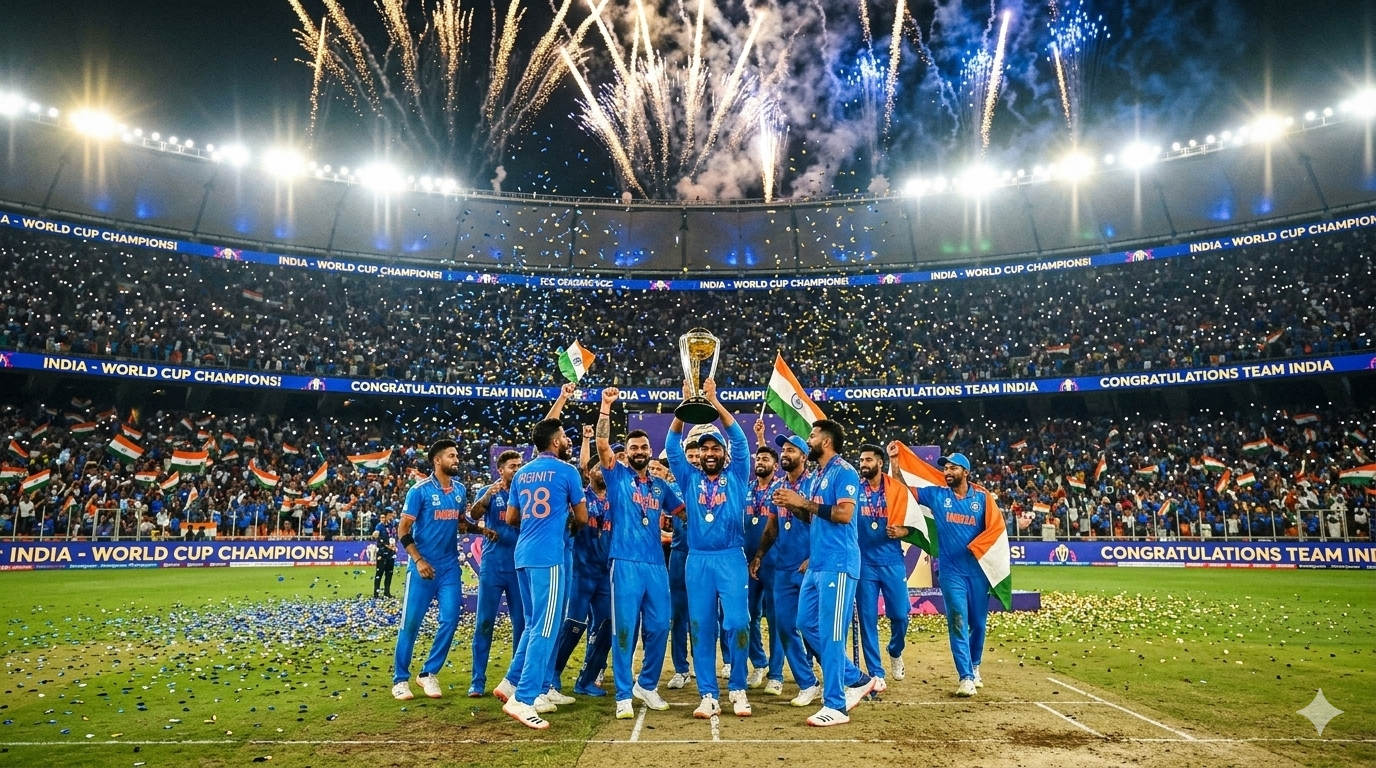
Long after the trophy had been lifted, long after the confetti had settled on the Narendra Modi Stadium’s outfield, long after the last of the one lakh fans had made their way home through the warm Ahmedabad night, the magnitude of what India had achieved on March 8, 2026 began to sink in.
This night — Abhishek Sharma’s 18-ball fifty, Sanju Samson’s 89 from 46 balls, Jasprit Bumrah’s 4 for 15, the 92-run powerplay, the 255-run total, the 96-run winning margin — this night added a new, golden chapter to cricket’s endlessly rich story.
India had not just won a cricket match. India had not just retained a title. India had made history in three separate, unprecedented ways, had done so in front of a billion supporters, had done so in the very stadium where the sport had previously broken their hearts, and had done so with a performance of such commanding quality that the cricket world could only stand and applaud.
Three T20 World Cups. Three titles. First to retain. First to win at home. First to three crowns.
It was, quite simply, one of the greatest nights in the history of Indian cricket.
📄 Final Scorecard Summary
🏳️ INDIA: 255/5 (20 overs)
Sanju Samson 89 (46) | Abhishek Sharma 52 (26) | Ishan Kishan 54 (25) | Shivam Dube 24* (6)
Bowling: J. Neesham 3/46 | L. Ferguson 0/48 | M. Santner 1/34
🏴 NEW ZEALAND: 159/10 (19 overs)
Tim Seifert 52 (23) | Mitchell Santner 43
Bowling: J. Bumrah 4/15 | A. Patel 3/27 | H. Pandya 1/22 | V. Chakravarthy 1/28
🏆 INDIA WON BY 96 RUNS