

GREENLAND – USA CONFLICT: HISTORY, GEOPOLITICS, AND THE STRUGGLE FOR STRATEGIC POWER IN THE ARCTIC
INTRODUCTION: A LAND OF ICE, SILENCE, AND STRATEGIC THUNDER
Greenland is one of the world’s most stunning contradictions — a land of endless white silence, yet a stage where some of the loudest geopolitical ambitions collide. With just over 56,000 people living across the largest island on Earth, Greenland seems too quiet, too remote, too frozen to be a centerpiece of international power struggles.

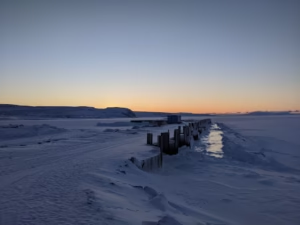
Yet it is exactly those qualities — its isolation, its resources, its position at the top of the world — that have placed Greenland repeatedly in the crosshairs of global powers.
For decades, the United States has viewed Greenland not merely as a neighbor across the Arctic, but as a strategic jewel — a location that offers military dominance, resource opportunities, and a foothold in an Arctic region melting faster than diplomacy can keep up with.
People often talk about a “Greenland–USA conflict,” but there has never been an open war or violent confrontation. Instead, this “conflict” is a mixture of:
-
strategic tension
-
military interests
-
resource competition
-
diplomatic disagreements
-
environmental and indigenous rights concerns
-
and high-stakes geopolitical maneuvering
This is not a conflict of soldiers and borders — it is a conflict of interests, influence, and control.
To understand it, we must walk through history, land on icy airfields with Cold War pilots, sit at political negotiation tables, follow the global race for Arctic control, and listen to the voices of Greenlanders who are often lost beneath the noise of superpowers.
CHAPTER 1: HOW GREENLAND BECAME A STRATEGIC OBSESSION
The Geography That Changed Everything
At first glance, Greenland is simply a massive ice-covered island wedged between the Arctic and Atlantic Oceans. But geography is destiny — and Greenland’s destiny is strategic power.
Greenland sits:
-
At the entrance of the Arctic Ocean
-
Between North America and Europe
-
Near major satellite and missile routes
-
On top of crucial natural resources
During World War II, its location became important. During the Cold War, it became essential. Today, in an era of climate change and melting ice that reveals new shipping routes and mineral wealth, it is becoming priceless.
The United States Notices Greenland (1940s)
When Nazi Germany occupied Denmark in 1940, Greenland — a Danish territory — was left vulnerable. The U.S. stepped in, positioning itself as Greenland’s protector and building military bases across the island.
The most important of these was Thule Air Base, constructed in 1951. Thule became:
-
a radar station
-
a nuclear surveillance shield
-
a launch-monitoring center
-
a Cold War listening post
Thule’s importance solidified U.S. presence on Greenlandic soil, and from that moment onward, Washington’s interest only grew.
CHAPTER 2: THE COLD WAR — THE BEGINNING OF A QUIET CONFLICT
A Base Built Without Consent
One of the earliest disputes — often seen as the first “Greenland–USA conflict” — was that Thule Air Base was built without properly consulting Greenland’s indigenous Inuit population.
Entire Inuit communities were displaced with little warning. Families were moved into harsh conditions to make room for U.S. defense operations.

This created lasting emotional, cultural, and political wounds.
Today, many Greenlanders view the base not just as a strategic site — but as a reminder of foreign dominance.
Nuclear Tensions and the 1968 Crash
In 1968, a U.S. B-52 bomber carrying nuclear weapons crashed near Thule, scattering radioactive debris across the ice.
The U.S. initially denied the presence of nuclear bombs — later admitting the truth.
This fueled outrage in Greenland and Denmark. It also created distrust that lasted decades.
Even now, the crash remains a symbol of:
-
secrecy
-
environmental danger
-
unequal partnership
And it shapes Greenlandic attitudes toward U.S. military presence to this day.
CHAPTER 3: THE VALUES CLASH — WHO OWNS GREENLAND’S FUTURE?
The U.S. Tries to Buy Greenland (Twice)
It sounds unbelievable — but the U.S. literally tried to buy Greenland.
First attempt:
In 1946, the U.S. offered Denmark $100 million to purchase Greenland outright.
Second attempt:
In 2019, a similar proposal resurfaced, sparking widespread global attention — and local anger. Greenlandic leaders responded sharply:
“Greenland is not for sale. Greenland is open for business, not purchase.”
The reaction exposed a deep divide:
-
The U.S. sees Greenland as a strategic asset.
-
Greenland sees itself as a homeland, a culture, a future independent nation.
Washington’s offer, even if strategic rather than imperial, was perceived as dismissive of Greenlandic identity.
Self-Rule Movements Strengthen
In 1979 and again in 2009, Greenland gained increasing levels of self-governance from Denmark.
Greenland now controls:
-
natural resources
-
domestic policy
-
infrastructure planning
Denmark still oversees:
-
defense
-
foreign policy
And this is where tension often arises: the U.S. negotiates military agreements with Denmark, but Greenland demands a seat at the table.
CHAPTER 4: THE MODERN “CONFLICT” — A GEOPOLITICAL TRIANGLE
The real conflict is not simply USA vs Greenland.
It is USA vs Greenland vs Denmark vs China vs Russia — all interacting in the rapidly changing Arctic landscape.
Let’s break this down.
1. The U.S. vs Denmark
While allies, Washington and Copenhagen often disagree about:
-
base expansions
-
environmental responsibility
-
economic development in Greenland
The U.S. prefers stronger military infrastructure.
Denmark prefers environmental caution and diplomatic stability.
2. The U.S. vs Greenland
Greenland’s leaders want:
-
economic investment
-
job creation
-
control over resources
-
progress toward independence
But they also reject any hint of territorial acquisition or dominance.
The U.S. wants:
-
secure military presence
-
influence before China or Russia move in
-
Arctic access
-
control of mineral resources
This creates friction around issues like:
-
mining permits
-
base expansions
-
foreign investment rules
-
transport and satellite networks
3. The U.S. vs China
China considers Greenland part of its “Polar Silk Road.” It has invested heavily in:
-
mining proposals
-
airports
-
infrastructure
The U.S. sees this as a threat.
In 2018–2019, China offered to build major airports in Greenland.
The U.S. immediately intervened — politically pressuring Denmark to block the deal.
To Greenland’s government, this felt like interference.
To the U.S., it felt like protecting national security.
4. The U.S. vs Russia
Russia, like the U.S., wants Arctic dominance.
The opening of the Northern Sea Route — a new shipping lane created by melting ice — has turned the Arctic into a battleground for:
-
commercial control
-
military positioning
-
energy exploration
Russia has built over 40 Arctic military facilities.
The U.S. now feels pressure to strengthen its presence — and that means Greenland becomes vital again.
CHAPTER 5: THULE AIR BASE — STILL THE HEART OF THE TENSION
Though built in the 1950s, Thule Air Base remains one of the most critical U.S. assets in the world.
It serves as:
-
a missile warning center
-
a satellite tracking station
-
a space surveillance hub
It watches over:
-
Russian missile launches
-
Arctic airspace
-
global satellite movement
Now, with increasing global tensions, the U.S. wants to upgrade Thule.
Greenland wants:
-
compensation
-
environmental cleanups
-
native involvement
-
infrastructure improvements
The negotiations are ongoing and not always smooth.
CHAPTER 6: THE RESOURCE RACE — MINERALS THAT COULD CHANGE THE WORLD
Greenland is sitting on:
-
rare earth metals
-
uranium
-
gold
-
copper
-
diamonds
-
oil and gas (though extraction is controversial)
Rare earth minerals are essential for:
-
smartphones
-
electric vehicles
-
satellites
-
military equipment
Currently, China dominates global rare earth production.
The U.S. wants alternatives — and Greenland is the perfect candidate.
However:
-
Greenlandic people worry about environmental damage
-
Denmark worries about international pressure
-
China is already competing for mining contracts
This creates a triangular conflict in almost every project.
CHAPTER 7: THE INDIGENOUS DIMENSION — THE MOST IMPORTANT BUT MOST IGNORED VOICE
Throughout all these geopolitical strategies, one group is often overlooked:
the Inuit people of Greenland.
Their concerns include:
-
displacement from U.S. military expansion
-
radioactive soil from past accidents
-
disrupted hunting routes
-
climate change affecting traditional life
-
limited local political power
Many Inuit see foreign involvement as:
“Decisions made about us, without us.”
Greenlanders want development — but development with respect, not dominance.
Their vision is a Greenland that is:
-
economically independent
-
culturally protected
-
environmentally sustainable
The U.S. often promises these things, but delivery is uneven.
CHAPTER 8: CLIMATE CHANGE — A NEW FRONTIER OF CONFLICT
The Arctic is warming four times faster than the global average.
As ice melts:
-
new islands appear
-
new sea routes open
-
new resources become accessible
-
new military routes emerge
This is transforming Greenland from a quiet icy landscape into a geopolitical hotspot.
Who benefits?
-
Shipping companies
-
Mining corporations
-
Military strategists
-
Global superpowers
Who suffers?
-
local wildlife
-
Inuit hunting traditions
-
coastal communities
-
fragile ecosystems
Climate change is not just an environmental reality —
it is a geopolitical weapon.
CHAPTER 9: A HUMAN VIEW — STORIES BEHIND THE STRATEGY
To write in a human voice, we must step away from facts and numbers — and listen to real people.
A fisherman in Ilulissat
He speaks of shrinking ice:
“The ice used to protect us. Now it betrays us. One day it is thick, the next it is gone. We are afraid to cross it.”
Military bases mean nothing to him. His conflict is survival.
A young student in Nuuk
She says:
“We want independence. But not at the cost of our land. We want opportunity, not exploitation.”
She sees the U.S. as both a future partner and a historical intruder.
An elder near Thule
He recalls the displacement:
“They told us to move in a few days. Our dogs, our homes, our graves — left behind. We were not human in their eyes, only obstacles.”
His grief is part of the Greenland–USA conflict too — a conflict of memory and trauma.
CHAPTER 10: THE FUTURE — HOW THIS “CONFLICT” EVOLVES
The Greenland–USA conflict will not become a military war.
It will remain a conflict of:
-
interests
-
resources
-
influence
-
identity
Possible future scenarios
1. Greenland moves toward full independence
The U.S. would likely support this — but also push for stronger military agreements.
2. Greenland positions itself between major powers
Balancing U.S., China, and Europe could bring wealth — or instability.
3. Greenland becomes a major Arctic hub
Shipping, mining, tourism, and research could boom.
4. Environmental collapse disrupts everything
Melting ice makes plans uncertain. Nature becomes the ultimate deciding force.
CONCLUSION: A CONFLICT WITHOUT GUNS BUT FULL OF CONSEQUENCES
There is no battlefield.
No armies.
No open war.
Yet the Greenland–USA conflict is real — a conflict of geopolitics, economics, ecology, history, and identity.