Denver Nuggets vs Los Angeles Clippers: Rivalry, Strategy & Playoff Legacy
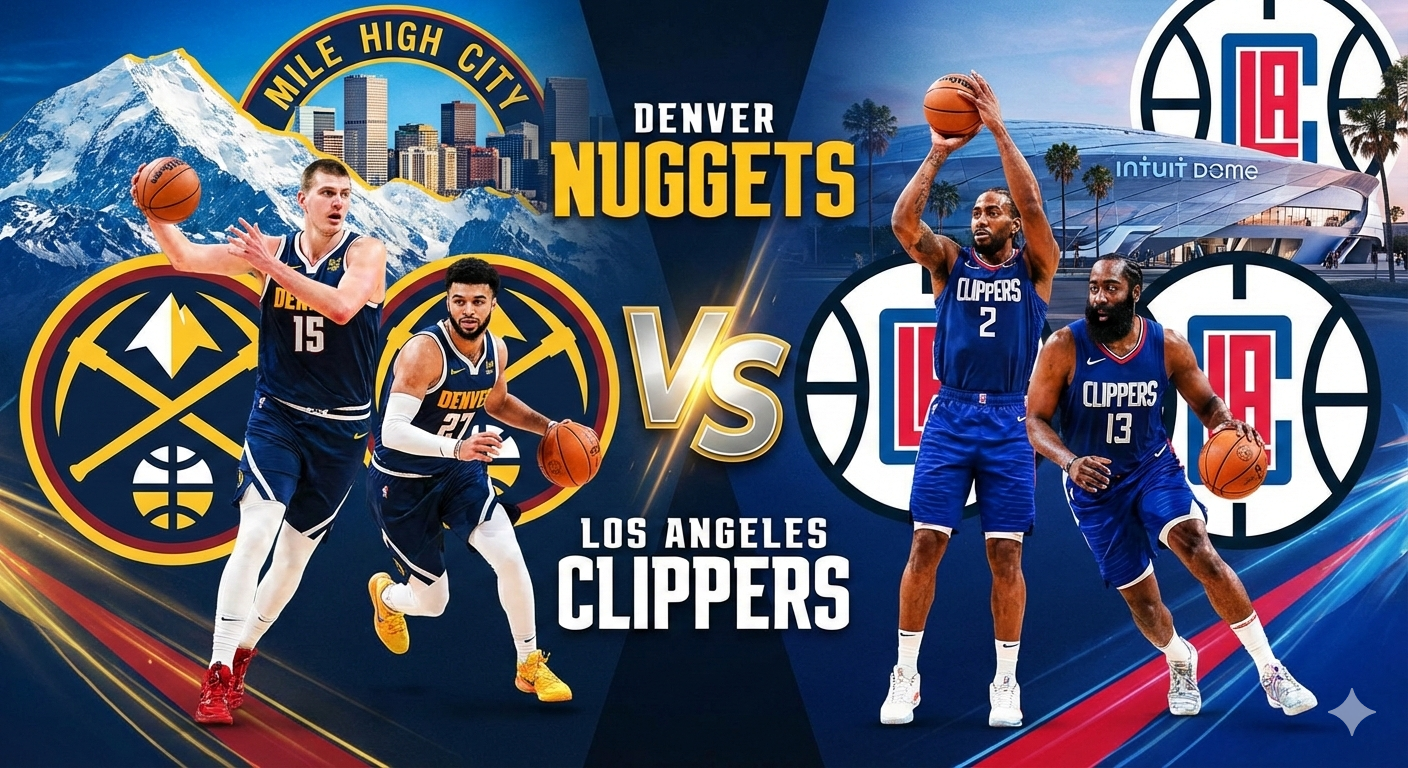
Denver Nuggets vs Los Angeles Clippers ,On nights when the stakes swell beyond the ordinary and the air inside the building seems to vibrate, you can feel the difference before the opening tip. It hums through the lower bowl, climbs the aisles, settles into the shoulders of players as they go through their final shooting routines. A Nuggets–Clippers game, particularly in the spring, carries that hum.

I remember one such night—late, tense, the kind of evening that leaves a residue long after the final buzzer. The arena lights dimmed, and somewhere in the darkness you could sense the collision of two franchises that have come to define contrasting paths to contention. On one side, the continuity and craft of the Denver Nuggets. On the other, the star-powered ambition of the Los Angeles Clippers.
In today’s NBA landscape—an era of player empowerment, pace-and-space geometry, and front-office boldness—the Nuggets and Clippers represent a referendum on team-building philosophy. Are championships forged patiently through development and internal belief? Or are they assembled through decisive swings, superstar pairings, and the urgency of a ticking clock?
This rivalry, though not ancient in the traditional sense, has come to feel elemental. It is about altitude versus Hollywood glare, subtle brilliance versus calculated dominance, and perhaps most of all, about how modern basketball decides its champions.
Origins and Identity: Two Franchises, Two Roads
To understand why these matchups feel so charged, you have to appreciate the histories that shaped them.
The Nuggets have long lived in the NBA’s margins. For decades, they were known for scoring flair and defensive indifference, for playoff appearances that hinted at something more but rarely delivered it. The altitude of Denver was always a factor; the identity was not always clear. The franchise’s transformation began not with a headline-grabbing trade but with a second-round draft pick in 2014—an unassuming Serbian center whose selection was once famously announced during a Taco Bell commercial.
That player, of course, is Nikola Jokic. And with him came a new philosophy: play through the center, literally and metaphorically. Build patiently. Develop relentlessly. Trust continuity.
The Clippers’ history is more volatile, more theatrical. For years, they were defined by dysfunction and irrelevance in a city dominated by purple and gold. The Lob City era brought electricity and respectability but fell short of ultimate validation. Then, in the summer of 2019, the franchise made its most audacious move, pairing Kawhi Leonard with Paul George in a bid to seize control of the Western Conference.
It was a declaration: The Clippers would no longer wait for relevance. They would take it.
The Bubble That Changed Everything
No single chapter in this rivalry looms larger than the 2020 Western Conference Semifinals inside the Orlando bubble. It was a series that reshaped reputations and recalibrated trajectories.
The Clippers entered as title favorites. Leonard was fresh off a championship run in Toronto, his playoff persona bordering on mythic. George, though occasionally streaky, was a two-way force capable of tilting games on both ends. The Clippers built a 3–1 series lead and appeared poised to dispatch Denver with clinical efficiency.
What followed remains one of the defining collapses of the era.
The Nuggets, anchored by Jokic’s orchestration and the incendiary scoring bursts of Jamal Murray, clawed back. Murray’s shot-making became incandescent—pull-up threes, twisting finishes, contested daggers. Jokic dissected double teams with surgical passes, manipulating weak-side defenders like chess pieces.
The Clippers, for all their talent, tightened. Rotations shortened. Isolation possessions multiplied. In Game 7, the offense stagnated into a sequence of forced looks and anxious dribbles. Denver ran away with it.
That series did more than eliminate a contender. It altered the psychological architecture of both franchises. For the Nuggets, it validated belief. For the Clippers, it exposed fragility.
Years later, every Nuggets–Clippers game carries an echo of that bubble.
Star Power: Contrasting Greatness
Nikola Jokic: The Maestro in the Middle
Jokic is an anomaly who has become the league’s gravitational center. He does not overwhelm with verticality or sprint through possessions with theatrical urgency. Instead, he bends games with geometry.
Watch how he initiates offense from the high post. The Nuggets space the floor in a 5-out alignment or flow into dribble handoffs that morph seamlessly into pick-and-rolls. Jokic reads the tag defender a beat before the tag occurs. He understands timing in a way that transcends scouting reports.
Against the Clippers, his brilliance becomes even more pronounced. When they deploy small-ball lineups—switch-heavy units designed to crowd the perimeter—Jokic punishes them on the block. He seals early in transition, forcing cross-matches. If they send a double, he finds the weak-side shooter. If they stay home, he methodically works into a soft hook or a patient up-and-under.
His leadership style mirrors his game: understated but immovable. Teammates orbit around his calm.
Jamal Murray: The Emotional Catalyst
Murray is Denver’s accelerant. Where Jokic is tempo control, Murray is ignition. His two-man game with Jokic is among the most devastating partnerships in modern basketball—an intricate dance of handoffs, ghost screens, and pocket passes.
The Clippers often counter with aggressive point-of-attack defenders, switching wings onto Murray to disrupt rhythm. But Murray thrives in chaos. He snakes through screens, manipulates bigs in drop coverage, and has developed a mid-range pull-up that punishes conservative schemes.
In elimination scenarios, Murray’s demeanor sharpens. He has shown a willingness to take—and make—the kind of shots that fracture defenses and psyches alike.
Kawhi Leonard: Precision and Silence
Leonard approaches the game like a craftsman. His footwork in the mid-post is textbook. Against Denver, he often hunts mismatches, backing down smaller defenders or rising over length with a high-release jumper that seems impervious to contests.
Defensively, he toggles between off-ball rover and on-ball eraser. When tasked with Murray, he uses strength and anticipation to deny easy entries into the two-man action. His playoff résumé carries weight; his presence alone recalibrates a series’ emotional balance.
Paul George: The Variable
George is the Clippers’ swing factor. When his jumper is pure and his defensive engagement high, he stretches Denver’s rotations to their breaking point. He thrives in early offense, attacking tilted floors before the Nuggets can set their shell defense.
Yet George’s narrative has often been complicated by inconsistency in high-leverage moments. Against Denver’s disciplined help schemes, his shot selection becomes critical. Does he attack closeouts decisively? Does he settle for contested pull-ups?
When George plays downhill and decisive, the Clippers’ offense flows with a rhythm that is difficult to counter.
The Coaching Chess Match
Behind the stars, the tactical duel between Michael Malone and Tyronn Lue adds another layer of intrigue.
Malone’s philosophy is rooted in trust and accountability. He empowers Jokic as a de facto offensive coordinator, encouraging read-and-react principles over rigid sets. Defensively, Malone emphasizes positioning and communication, often toggling between drop coverage and late-switch schemes depending on personnel.
Lue, meanwhile, is a master of in-series adjustment. He is unafraid to bench established players if matchups demand it. His willingness to experiment—switching everything one night, trapping aggressively the next—keeps opponents guessing.
In tight postseason games, coaching manifests in subtle ways: a well-timed timeout to halt a run, a defensive wrinkle that steals two possessions, a staggered rotation that preserves a star’s legs for crunch time.
When these teams meet, every substitution feels deliberate.
Tactical Fault Lines
Jokic vs. Small-Ball
The Clippers’ instinct in recent years has been to downsize, surrounding Leonard and George with switchable wings. Against most opponents, this alignment generates turnovers and fuels transition opportunities.
Against Jokic, it’s a gamble.
If the Clippers front the post, Denver counters with high-low actions and weak-side cuts. If they double from the baseline, Jokic skips passes to the opposite corner. The math becomes unforgiving: surrender open threes or concede efficient post scoring.
Clippers’ Wing Defense vs. Murray
Few teams can throw as many lengthy defenders at Murray as the Clippers. Leonard, George, and a cadre of rangy role players disrupt passing lanes and contest pull-ups.
Denver’s counter is movement. They run Spain pick-and-rolls, slip screens early, and force defenders to navigate layers of action. Murray’s growth as a passer has made trapping him riskier; he now finds short-roll options and weak-side shooters with greater consistency.
Transition vs. Half-Court Precision
The Clippers are at their best when they convert defense into offense. A deflection becomes a run-out, a contested rebound sparks a quick-hitting drag screen in early offense.
The Nuggets prefer deliberation. Their half-court execution is surgical, their turnover rate typically low. In matchups between these teams, the possession battle is pivotal. If Denver controls tempo and limits live-ball turnovers, they tilt the game toward their comfort zone. If the Clippers accelerate, they inject volatility.
Bench and Depth
Championship aspirations hinge not just on stars but on reliability from the margins. Denver’s bench units often mirror the starters’ principles—ball movement, cutting, spacing. The Clippers, historically, have relied on bench scoring bursts to swing quarters.
Depth becomes magnified in long series. Foul trouble, fatigue, minor injuries—all of it tests roster construction.
Mentality and Identity
The Nuggets carry themselves like a team that knows who it is. Their core has endured playoff heartbreak and ultimate triumph. Continuity has fostered a collective memory: they understand the emotional rhythm of a series.
The Clippers operate with urgency. Leonard’s contract timeline, George’s tenure, the franchise’s desire to validate its bold moves—these factors create an undercurrent of pressure. Urgency can sharpen focus; it can also constrict.
In elimination games, Denver has often exhibited poise. The Clippers, post-bubble, have shown resilience of their own, pushing deep into the postseason with adaptive strategies. But the psychological interplay remains a subtext in every meeting.
Analytics in Context
When you peel back the narrative and examine the numbers, the matchup reveals fascinating patterns. Denver’s offensive rating in recent head-to-head stretches has often climbed when Jokic plays extended minutes against small lineups, reflecting the efficiency of post touches and kick-out threes.
Conversely, the Clippers’ net rating spikes when they win the turnover battle and generate transition points. Their defensive rating improves markedly when they switch seamlessly and limit Murray’s paint touches.
But statistics, while illuminating, do not capture the full texture. A single timely three can outweigh five possessions of marginal efficiency. Analytics frame the discussion; they do not conclude it.
Market Dynamics and Fan Culture
Denver’s rise to championship legitimacy has galvanized its fan base. Ball Arena hums with belief, the altitude amplifying both lungs and legs. There is a communal pride in watching a homegrown superstar redefine the center position.
In Los Angeles, the Clippers navigate a different reality. They share a city—and for years, an arena—with the Lakers. Media scrutiny is relentless. Expectations are immediate. Yet there is a growing identity around the Clippers: resilient, blue-collar within a glamorous market.
When these teams clash in L.A., the building feels charged with narrative tension. In Denver, the atmosphere leans defiant.
The Western Conference Implications
The Western Conference is unforgiving. Windows close quickly. Jokic remains in his prime, his game less dependent on athleticism than anticipation. Murray’s trajectory suggests sustained potency.
For the Clippers, Leonard and George represent both peak talent and ticking clocks. Health looms as a perennial variable. Roster flexibility becomes paramount as contracts age and cap sheets tighten.
Every Nuggets–Clippers series, real or hypothetical, feels like a referendum on whose timeline aligns best with opportunity.
A Rivalry Reflecting the Modern Game
What makes this matchup compelling is not just the talent but the philosophical contrast. Denver’s offense flows through a center who reimagines positional boundaries. The Clippers rely on wings who embody the league’s two-way ideal.
It is finesse versus force, patience versus pressure, orchestration versus isolation.
And yet, at its highest level, the rivalry transcends dichotomy. Both teams adapt. Both evolve. The Nuggets have incorporated more defensive versatility; the Clippers have leaned into ball movement and collective playmaking.
Each meeting becomes a study in adjustments.
Closing Reflections
Late in tight games between these teams, the arena quiets in a particular way. Possessions stretch. Every cut, every screen, every defensive rotation carries weight.
You watch Jokic at the elbow, surveying. You watch Leonard on the wing, eyes steady. You sense Murray’s readiness to rise, George’s determination to answer. Coaches pace, assistants whisper, fans hold breath.
The final buzzer eventually sounds. One side walks off affirmed, the other recalibrating.
But the rivalry endures.
In the evolving tapestry of modern NBA basketball, Nuggets vs. Clippers has become more than a matchup. It is a dialogue about team-building, about resilience, about the delicate balance between talent and cohesion.
And as long as these rosters intersect under bright lights and postseason pressure, that hum—the one you feel before tip-off—will remain.