Delhi MCD By-Election 2025 Results: Full Analysis, Party Performance & Impact on Delhi Politics
Delhi MCD By-Election 2025: Results That Could Redefine the Capital’s Political Landscape
The 2025 Municipal Corporation of Delhi (MCD) by-election results have emerged as one of the most significant political markers for the city. With voting held across 12 wards, these results not only reshape the balance of power within the corporation but also offer a real-time snapshot of Delhi’s post-assembly-election mood—especially after the Bharatiya Janata Party’s (BJP) sweeping victory in the February 2025 Assembly elections.
MCD By-Election 2025: Key Background
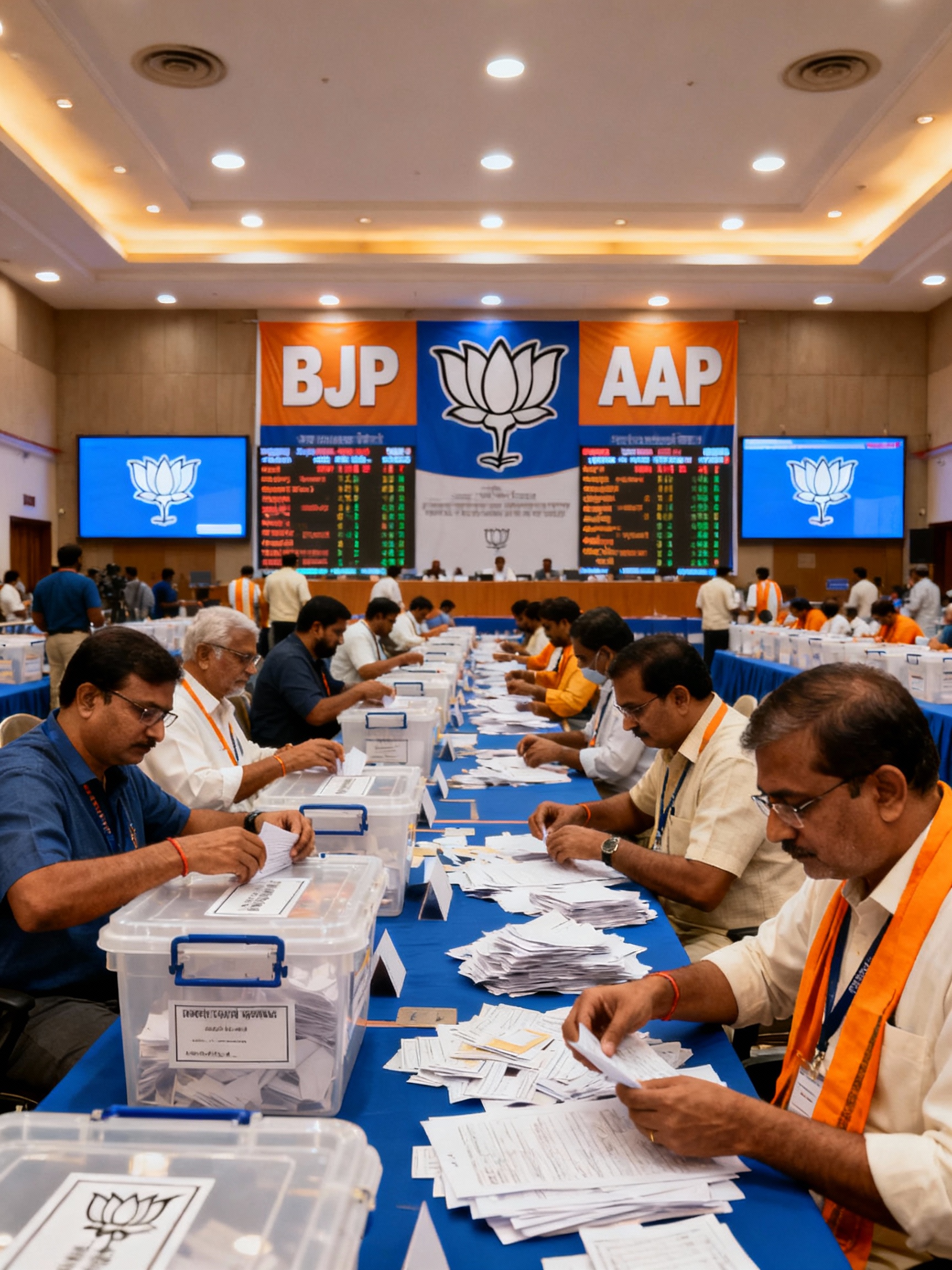
The by-elections across 12 MCD wards were conducted on 30 November 2025, featuring 51 candidates, including 26 women. These elections became necessary as 11 sitting councillors were elected to the Delhi Assembly or Parliament, while one seat fell vacant due to other reasons.
Before the by-polls, 9 of these 12 seats were held by the BJP, and 3 by the Aam Aadmi Party (AAP). With this distribution, the results were expected to clearly show whether each party has managed to retain ground or is losing voter confidence.
A total of 580 polling booths were set up, and the overall voter turnout settled at 38.51%, considerably lower than the 50.47% turnout recorded in the 2022 MCD elections.
Current MCD Power Structure
The MCD comprises 250 seats, and at present, the BJP is the largest party—governing the civic body with a comfortable majority.
MCD House Composition (Approximate)
| Party | Seats (Approx.) | Status |
|---|---|---|
| BJP | 115–116 | Largest party with clear majority |
| AAP | 99 | Main opposition despite recent setbacks |
| Indraprastha Vikas Party (IVP) | 15 | Small but influential “kingmaker-like” presence |
| Congress | 8 | Attempting to revive its shrinking base |
If BJP secures a majority of the 12 by-poll seats, its strength may rise to 127, significantly tightening its grip over the civic body. Meanwhile, AAP and Congress view these elections as an opportunity to demonstrate that their political relevance in Delhi continues despite recent losses.
Key Wards to Watch
Some wards have gained particular attention due to the prestige attached and the political signals their results send citywide.
Shalimar Bagh-B
A prestige ward for both BJP and AAP. With the BJP’s current advantage in the 250-member House and the leadership of Chief Minister Rekha Gupta under scrutiny, this ward has become a symbolic battleground.
Greater Kailash (Ward 173) – Women-Reserved
In 2022, BJP’s Shikha Roy won this seat and is contesting again in 2025.
She faces tough competition from:
-
Eeshna Gupta (AAP) – a young face representing “new politics”
-
Garvit Singhvi (Congress) – turning the contest triangular
Other Prominent Wards
Wards such as Chandni Mahal, Chandni Chowk, Dakshinpuri, Sangam Vihar, and Dwarka-B will offer insights into the political sentiments of Old Delhi, South Delhi, and the outer regions.
Dakshinpuri (Ward 164) – SC-Reserved
Won by AAP’s Prem Chauhan in 2022, the ward is once again witnessing a tough contest. Results from this seat may indicate whether Dalit and other marginalized communities remain aligned with their previous political choices.
Low Voter Turnout: What It Reveals
The by-elections recorded a 38.51% turnout, with Chandni Mahal posting the highest turnout at 55.93%. Many middle-class and urban pockets witnessed significantly lower participation.
Analysts attribute this low turnout to:
-
General public indifference towards municipal polls
-
A perception that MCD elections carry less impact than Assembly or Lok Sabha votes
-
Sluggish ground campaigns and inadequate focus on local issues in some areas
However, for those who did vote, these elections mattered deeply—since civic concerns like garbage management, sewage, roads, streetlights, parks, and primary health facilities fall directly under the MCD.
Why These Elections Are Crucial for the BJP
After the BJP’s massive victory in the 2025 Delhi Assembly elections, this is the party’s first electoral test. A majority win in the by-polls would indicate sustained voter trust in the new government and Chief Minister Rekha Gupta’s governance model.
The BJP highlighted several key issues during its campaign:
-
Expansion of e-bus services and upgrades in public transport
-
Improved health facilities, insurance schemes, and mohalla-level health initiatives
-
Efficient management of major public festivals—such as Chhath Puja—to strengthen its governance image
A strong BJP performance will strengthen its hand in:
-
The 2026 MCD Budget
-
Standing Committee decisions
-
The next Mayor election
A poor outcome, however, may suggest that voters are more cautious at the municipal level than at the state level.
AAP’s Chance at Revival
After winning the MCD in 2022 by ending BJP’s 15-year rule, AAP faced setbacks due to political disruptions and its defeat in the 2025 Assembly polls. The by-elections thus become an opportunity for AAP to re-energize its cadre and reclaim voter trust.
AAP’s outreach includes:
-
Highlighting past achievements in cleanliness, waste management, and park revitalization
-
Emphasizing its traditional governance model of free/low-cost essential services
-
Fielding young candidates—especially women and community workers—to project renewed energy and inclusiveness
A strong outcome for AAP would signal that its influence among urban poor and middle-class voters remains intact despite recent losses.
Congress and Smaller Parties: Fighting for Relevance
For the Congress party, the by-elections serve as a potential last call for revival. With only 8 MCD seats, the party is trying to rebuild its grassroots appeal by nominating several local workers—including five women.
The Indraprastha Vikas Party (IVP), with 15 councillors, already plays a balancing role in civic politics. If the gap between BJP and AAP remains narrow, smaller parties and independents could become even more crucial—especially during mayoral elections and committee formations.
What’s at Stake for Delhi Voters
Although municipal elections may lack the glamour of Assembly or Lok Sabha polls, everyday civic life is shaped directly by the MCD. The quality of roads, garbage collection, parks, street lighting, and dispensaries determines how citizens experience the city on a daily basis.
These results will reveal:
-
Whether residents have noticed improvements in sanitation and civic services
-
Whether BJP’s public transport and health initiatives are resonating with voters
-
Whether AAP’s earlier governance model still holds appeal
-
Whether Congress’s “local connect” remains alive or has faded
Each winning or losing seat represents hundreds of households and their everyday challenges.
Wider Impact on Delhi’s Political Narrative
The MCD by-poll results will extend beyond civic governance and influence the trajectory toward:
-
The 2027 Delhi Assembly elections
-
Future Lok Sabha contests
-
Opposition alliance negotiations and seat-sharing talks
If BJP performs strongly, it will brand this as endorsement of its “double-engine” governance model.
If AAP stages a comeback, it will claim voters still remember and value its governance.
If Congress or smaller parties surprise, their political bargaining power will grow.
Political observers see this by-poll as nothing short of a “mini-referendum” on the current political environment in Delhi.
Human Angle: Streets, Neighborhoods & Everyday Aspirations
Behind every EVM number lies a personal story:
-
A resident who voted hoping long-pending garbage issues will finally be resolved
-
An elderly citizen expecting improved medicines and care in local dispensaries
-
A young mother voting for a woman candidate believing issues of safety and park maintenance will get more attention
These small, personal expectations form the real foundation of democracy.
What Lies Ahead
As counting progresses and ward-wise results emerge, political parties will project their own narratives—some calling it a “mandate,” others a “first session in a long match.”
But beyond politics, the real test begins after the results:
-
Will the winning councillors deliver noticeable improvements?
-
Will BJP—if strengthened—accelerate collaboration between the MCD and state government?
-
Will AAP and Congress—if they gain ground—offer constructive opposition focused on local development?
Ultimately, the 2025 MCD by-election reminds us that democracy thrives not only in big rallies or speeches, but also in the quiet lanes where polling officers set up EVMs at dawn, where elderly couples walk to vote, and where first-time voters realize that the ink on their fingers holds the power to shape the city’s future.