Christmas: A Tapestry of Light in the Winter Dark – History, Traditions, and Global Impact
Christmas: A Tapestry of Light in the Winter Dark
I remember the first Christmas I truly felt the weight of it—not as a child tearing into presents under a sagging pine tree, but as a young man wandering the snow-swept streets of a small Bavarian village in Germany. It was 1992, the Wall had fallen just three years prior, and the air hummed with a fragile optimism. Candles flickered in every window, their warm glow punching holes in the endless night, while the scent of Glühwein mingled with the sharp bite of pine. Strangers pressed mugs of spiced wine into my hands, singing carols in a language I barely understood, yet the melody wrapped around my heart like an old friend’s embrace. That night, amid the laughter and the chill, Christmas revealed itself not as a date on a calendar, but as a shared ache for warmth, connection, and something eternal. It’s this feeling—universal, elusive, profoundly human—that draws us back year after year, believers and skeptics alike, into the holiday’s embrace.
The Origins: Echoes from Ancient Fires
Christmas didn’t spring fully formed from the pages of the Bible; it was woven from threads of history, faith, and forgotten rituals, layered over centuries like sediment in a riverbed. Picture the world two millennia ago: the Roman Empire sprawling under Emperor Constantine, who in 336 AD declared December 25 as the date to celebrate Christ’s birth. Why then? No shepherd’s logbook pins the exact day, but savvy church fathers aligned it with the winter solstice, that longest night when ancient peoples from Saturnalia revelers in Rome to Yule feasters in Scandinavia kindled fires against the dark.
Pagan roots run deep. The Norsemen dragged evergreens into their halls as Yule logs burned for twelve days, warding off trolls and inviting the sun’s return. Druids in Celtic groves harvested mistletoe, its white berries symbolizing life’s persistence through frost. Saturnalia’s wild abandon—masters serving slaves, gifts exchanged in raucous markets—morphed into early Christian carousing. By the fourth century, as Christianity spread like wildfire through Europe, these festivals were baptized into the faith. Pope Gregory I, ever the pragmatist, advised missionaries in 601 AD to consecrate pagan shrines rather than raze them, letting old gods fade into the Nativity’s shadow.
Through the Middle Ages, Christmas evolved in fits and starts. In England, mummers in motley masks paraded from manor to hovel, performing bawdy plays of Herod and the Magi. The Reformation tried to purge the “popish” pomp—Oliver Cromwell’s Puritans banned it outright in 1647, calling it a pagan relic—but the people rebelled with secret wassailing and mince pies stuffed with forbidden beef. Across the Channel, French peasants lit bonfires on Christmas Eve, believing the Christ child rode the flames. These origins remind us: Christmas is less invention than inheritance, a holiday born of humanity’s defiance against winter’s despair.
The Heart of Faith: A Savior in the Straw
For the billion-plus Christians worldwide, Christmas pulses with theological fire—the Incarnation, God stepping into skin, vulnerability wrapped in swaddling clothes. The Gospel of Luke paints it vividly: shepherds trembling under angel song, Magi traversing deserts with gold and myrrh. Theologically, it’s the pivot of salvation history, the moment divine light pierced human brokenness. “And the Word became flesh and dwelt among us,” John writes, a verse that has haunted theologians from Augustine to Karl Barth.
Rituals born of this truth shape the season’s soul. Midnight Mass in Vatican City draws pilgrims shivering in St. Peter’s Square, the Pope’s voice echoing through the night. In Ethiopia’s rock-hewn churches, Genna celebrations blend soccer games with feasts of doro wat, chicken stew simmered for days. Filipino Simbang Gabi novenas cram cathedrals from December 16, a nine-day dawn vigil culminating in star-shaped lanterns swaying like fireflies. Faith infuses the ordinary: a Mexican posada procession knocking on doors, reenacting Mary’s rejection; a Swedish Lucia procession where blonde girls in candle crowns parade saffron buns, symbolizing light’s triumph.
I’ve knelt in a candlelit Filipino church at 4 a.m., the humid air thick with incense and anticipation, feeling the story’s raw power. It’s not abstract doctrine; it’s a reminder that the divine chooses stables over palaces, inviting the lowly to the feast.
Traditions Woven Across Continents
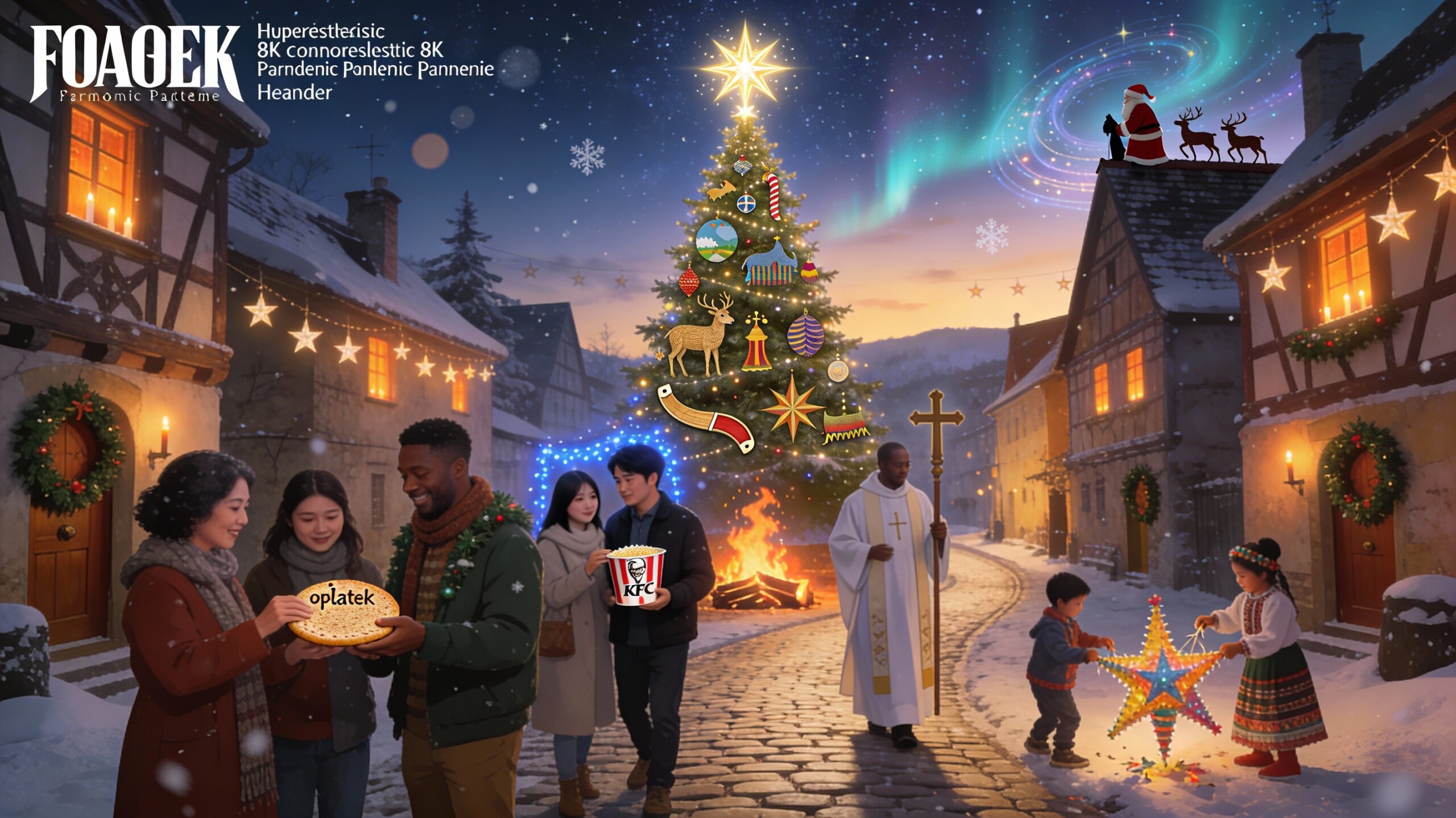
Travel the world at Christmas, and you’ll find a kaleidoscope of customs, each a window into cultural soul. In Europe, it’s hearth and history. England’s pantomimes turn pantos into riotous family theater—oh yes it is!—with Widow Twankey cracking jokes amid sleigh bells. Poles share opłatek, unleavened wafers broken and crossed over wishes, while Germans tuck carp under beds for luck (and fresh fish). Sweden’s Julotta service at dawn follows a smorgasbord of ham, lutefisk, and rice pudding hiding an almond for the lucky soul who marries next.
Cross to the Americas, and joy explodes. Mexico’s Las Posadas caravans wind through streets, piñatas bursting with candy under starry skies. In the U.S., drive through the neon frenzy of Dyker Heights in Brooklyn, where Italian-Americans drape houses in a million lights. Guatemala’s giant paper balloons float skyward, prayers inscribed on tissue paper. South America’s gauchos in Argentina roast cordero over asado pits, fireworks painting the pampas.
Asia reimagines it vibrantly. Japan’s Kuri-mas tree markets sell blue-tinted firs; couples flock to KFC for buckets of fried chicken, a 1970s ad campaign turned tradition. The Philippines, Asia’s Christmas capital, starts September 1 with carols and parols, bamboo lanterns evoking the Star of Bethlehem. India’s Goan villages blend Konkani hymns with vindaloos; even in bustling Mumbai, street vendors hawk plum cakes.
Africa pulses with rhythm. Ethiopia’s Timkat follows Genna with Epiphany processions, priests splashing holy water. South Africa’s braais unite families under jacaranda trees, while Nigeria’s Igbo masquerades dance through villages. Australia’s beachside barbecangs see Santa surfing Down Under, prawns sizzling as carols play.
These aren’t footnotes; they’re living tapestries. In the Philippines, I’ve joined midnight Mass in Manila’s slums, where barefoot children sang amid poverty’s grip, their voices piercing the soul.
Santa’s Sleight of Hand: From Myth to Icon
No figure looms larger than Santa Claus, that jolly amalgam of saint and salesman. He traces to St. Nicholas, fourth-century bishop of Myra, famed for secret gifts to the poor—dowries for impoverished girls, tossed through windows in gold balls. Dutch Sinterklaas arrived in America via settlers, morphing into Kris Kringle via German Christkindl. Clement Clarke Moore’s 1823 “A Visit from St. Nicholas” gave him his twinkling eyes and reindeer fleet, while Thomas Nast’s Harper’s illustrations in the 1860s fleshed out the red-suited elf at the North Pole.
The Christmas tree? A German import, courtesy of Martin Luther, who strung candles on pines to mimic starlight. Victorian England popularized it; Queen Victoria and Prince Albert posed under one in 1848, igniting a frenzy. Gifts, once symbolic frankincense and myrrh, ballooned via industrialization—Sears catalogs hawking toys by 1900.
Commercialization peaked with Coca-Cola’s 1931 Santa ads by Haddon Sundblom, cementing the rosy-cheeked image. Today, Black Friday kicks off the frenzy, Amazon drones shadowing reindeer. Yet beneath the gloss lies generosity’s spark: Toys for Tots, Salvation Army bells. Santa endures because he taps our childlike wonder, whispering that magic lingers.
Christmas in the Digital Glow
Modern Christmas shimmers through screens and streams. Hollywood’s yuletide machine churns classics—”It’s a Wonderful Life,” where George Bailey rediscovers purpose; “Home Alone,” Kevin’s chaotic triumph. Mariah Carey’s “All I Want for Christmas Is You” has grossed $130 million in royalties alone, inescapable from TikTok dances to Spotify playlists.
Social media amplifies it: Instagram reels of gingerbread empires, Twitter threads debating “Die Hard” as holiday fare. Virtual gatherings bridged pandemic isolation—Zoom carol sings, NFT advent calendars. Families morph too: blended broods via divorce, chosen kin in queer communities, elders Skyping grandkids. Traditions adapt—elf on the shelf spies for Santa, now with AI apps tracking “naughty” lists.
I’ve watched my own family shift: from raucous Italian feasts to quiet video calls, the love undiminished, just refracted through pixels.
The Global Engine: Commerce and Compassion
Christmas pumps $1 trillion into the world economy annually—retail surges 20% in the U.S., China’s Yiwu market ships 80% of global ornaments. Tourism booms: New York’s Rockefeller tree draws millions; Lapland’s Santa Village rakes in €200 million. Charity swells too—$500 billion donated yearly, from Toys for Tots to Heifer International’s livestock gifts.
Culturally, it binds. In Japan, where Christians are 1%, Kuri-mas boosts GDP by 0.3%. India’s malls twinkle despite Hindu dominance. Yet impact ripples: sweatshops stitching elves under deadline, Arctic villages disrupted by cruise ships.
Unwrapping the Secular Gift
Secular Christmas thrives, a cultural colossus transcending pews. “Xmas” trees grace atheist homes, “Happy Holidays” cards unite faiths. Humanists host solstice suppers; Jews spin Hanukkah bush hybrids. Why the pull? Psychologists cite “affective forecasting”—we crave joy’s anticipation. Winter’s gloom begs festivity; oxytocin from hugs combats Seasonal Affective Disorder.
In multicultural Canada, I’ve seen Sikh families deck halls alongside Diwali lamps, the shared light forging bonds.
Shadows in the Snow: The Holiday Blues
Not all is merry. Consumerism devours: 25 million tons of U.S. trash post-holidays, plastic reindeer choking landfills. Loneliness afflicts 20%—divorcees, immigrants, the grieving. “Blue Christmas” Elvis crooned of heartache. Mental health crises spike; UK suicides dip, but debt-fueled depression rises.
Critics decry Hallmarkification—canned nostalgia erasing nuance. Environmentalists tally aviation emissions from family flights. Yet resistance blooms: “Buy Nothing Christmas,” zero-waste swaps, mindful minimalism.
The Unquenchable Flame
Strip away the tinsel, and Christmas endures through its virtues: kindness as currency, generosity as rebellion. Stories abound—a Polish stranger shoveling an elder’s walk unasked; Tokyo’s Christmas cakes shared with homeless. It’s hope incarnate, a pause to affirm life’s fragility and beauty.
In a fractured world—wars raging, screens isolating—Christmas insists on incarnation: showing up, flesh and all.
Echoes into Tomorrow
As climate shifts solstices and AI crafts carols, Christmas will morph, resilient as ever. Perhaps virtual realities host global sing-alongs; lab-grown trees end deforestation. But its core—a light kindled against encroaching night—will persist. I’ve chased it from Bavarian villages to Manila streets, and each time, it circles back to that simple truth: in giving, we receive; in gathering, we heal.