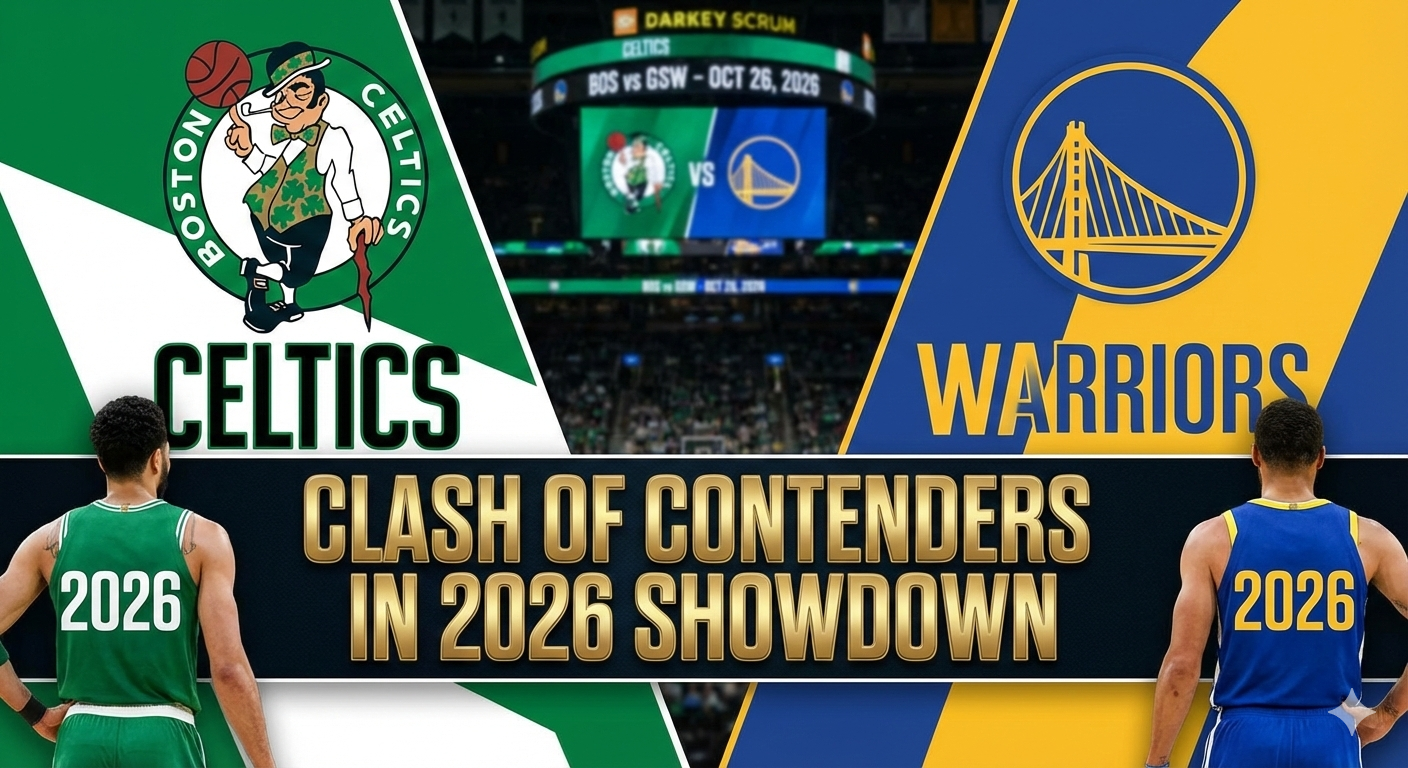
Celtics vs Warriors: Clash of Contenders in 2026 Showdown
“A Collision of Eras and Expectations”
It was an unusually cold night in San Francisco when the Celtics boarded their flight across the country, pulling on hoodies with snowflakes decorating the gym bags. In Boston, the idea of snow in February is part of the city’s fabric; here in the Bay Area, it’s almost absurd. Yet, the chill wasn’t just weather. It was the tension of an NBA world watching this game—Celtics vs. Warriors—feel like more than a February regular-season tilt.

The venue was the Golden State Warriors’ Chase Center, but the backdrop extended far beyond the hardwood. It was the first meaningful encounter between these two franchises this season, but not a mere statistical entry. It was a narrative collision—East vs. West, tradition vs. reinvention, experience vs. evolving identity. The stakes? More than a single win, more than a box score line; it was about legacy, health, and momentum heading into the final months of the NBA season.
For the Celtics, the trip to the West Coast signaled something they’ve become remarkably good at: resilience. For the Warriors, it was a test of adaptability in the face of injury and roster overhaul. And for basketball fans around the globe, it was a reminder that in the modern NBA, titanic matchups don’t require the playoffs to feel consequential.
Latest Context: News Shaping the Battle
Coming into this game, one piece of news overshadowed several others: Stephen Curry remains sidelined with a knee issue and will miss this contest, marking at least his sixth straight absence. The injury situation around Curry—stemming from runner’s knee (patellofemoral pain syndrome)—has been the defining offseason narrative for the Warriors. Despite a clean MRI, persistent swelling and discomfort have kept him off the court, leaving Golden State without its most iconic offensive engine.
Into this void steps Kristaps Porzingis, freshly acquired and poised to possibly make his Warriors debut against the Celtics. His arrival has been one of the season’s most intriguing twists, offering a new offensive focal point for a team suddenly needing to reinvent its identity.
From Boston’s side, the narrative is slightly different but equally compelling. After the All-Star break, the Celtics arrived in San Francisco strong—sitting in prime position in the Eastern Conference standings and playing disciplined, defense-focused basketball. They’ve shown balance in both ends, especially in rebounding and limiting opponents’ scoring opportunities, making them one of the league’s most consistent two-way teams this season.
These storylines—injury, reinvention, and consistency—create a texture to this matchup that pure box scores can never summarize.
The Weight of History Between Boston and Golden State
Long before the modern era, these two franchises carried legacies of their own. The Celtics are synonymous with NBA royalty—multiple championships, legendary dynasties, and a culture that treats playoff basketball with reverence. Winning in Boston isn’t celebrated; it’s expected.
The Warriors, too, built their own dynasty not long ago—championships, revolutionary offense, and modern basketball philosophy grounded in spacing and perimeter shooting. In the 2010s, they reshaped basketball with their revolution in ball movement and three-point volume.
Yet there’s a juxtaposition here: for Boston, tradition remains tangible—etched in banners, chants, and history books. For Golden State, tradition has been freshly forged by modern excellence. So when these two meet, it’s not just a contest of two teams; it’s a contest of basketball ideologies.
Current Season Tales: Talent, Tactics, and Turning Points
Boston’s Blueprint for Consistency
Boston’s strength this season has been its discipline. Offensively dynamic and defensively sound, the Celtics hold impressive numbers on both ends of the floor. They average efficient scoring with accuracy—excellent field goal and three-point percentages—while forcing opponents into turnovers and limiting second chances. Their rebounding edge gives them extra possessions, turning defensive stops into offensive opportunities.
Yet what’s noticeable isn’t just the stat sheet, but how they play. The Celtics move bodies before they move the ball. Their spacing isn’t static—it’s intentional. Receivers are constantly cutting, crashing, or repositioning. This isn’t basketball for the sake of spectacle; it’s basketball by design.
Jaylen Brown has been a stalwart this season, asserting his scoring with poise and power. Another layer has been Derrick White, whose gritty playmaking often goes unnoticed amidst bigger names but whose impact is real: high assists, intelligent defense, and a level of maturity that anchors Boston’s secondary playmaking.
Meanwhile, whispers about Jayson Tatum’s rehab progress from a torn Achilles add emotional weight. If Tatum returns healthy later in the season, this Celtics squad could shift from consistent contender to championship favorite.
Golden State’s Adaptation: A New Identity in Transition
Without Curry, the Warriors have been forced into a new identity this season—one where spacing isn’t centered around one of the greatest shooters ever, but instead shared among emerging scorers and strategic vision.
In comes Porzingis, whose mere presence alters defensive schematics. A 7′2″ floor-spacer and rim protector, he gives Golden State a focal point both inside and out. The Warriors’ offense, traditionally fluid and perimeter-centric, suddenly carries a new dimension—pick-and-pop threat, interior scoring, and defensive rim coverage.
Yet basketball is as much psychological as physical. Warriors coach Steve Kerr has spoken openly about mitigating pressure around Curry’s injury and giving his team freedom to explore new configurations. The question facing Golden State isn’t merely tactical; it’s cultural—can this roster evolve beyond the Curry-centric identity that defined its past?
And that’s where matchups like these become invaluable. Against a disciplined team like Boston, the Warriors are being stress-tested in real time.
The In-Game Chess Match: Strategy Meets Execution
One of the most beautiful layers of basketball is how strategy plays out live. Before a JV contest, coaches dole out instructions on X’s and O’s. In elite settings, adjustments become rapid and intuitive.
Against Boston, the Warriors face a defensive unit that plays with intelligence and patience. Boston’s rotation is less about hounding isolation scorers and more about control—deny clean entry passes, collapse on drives, and funnel dangerous shooters into contested jump-outs.
This neutralizes teams that rely on rhythm scoring.
Golden State counters with unpredictability. Without Curry, their offense is less scripted and more opportunistic: ball movement, weak-side spacing, kick-outs, and open drives. Porzingis, if on the court, becomes an offensive pivot—not just a scorer, but a gravity sitter. His presence forces rotations, which in turn creates open opportunities for shooters and cutters.
Defense is where this matchup gets truly fascinating.
Boston defends with discipline, but Golden State pressures with aggression. It’s not merely about contesting shots; it’s about forcing decisions, pushing the ball in transition, and converting defense into offense. And while statistics matter, they only tell part of the story. In clutch moments, defensive discipline often outweighs offensive creativity—and vice versa.
Emotion and Psychology: The Human Elements
Basketball is numbers on the scoreboard, but beyond that scoreboard are human beings—players whose confidence fluctuates with every made shot, missed free throw, and strategic adjustment.
For the Celtics, this game is validation—proof that their identity can withstand any opponent, even across the country, even in the absence of one of their biggest stars. Their confidence isn’t flippant—it’s earned. The Celtics understand that regular-season wins like this build cultural currency heading into play.
For the Warriors, this game is meaningful growth. Without Curry, without familiarity, they are learning to produce offense that isn’t dependent on one man. Porzingis isn’t merely an addition; he is a reflection of a franchise learning to adapt without its historic anchor.
This psychological adjustment—embracing evolution instead of resisting absence—is one of the vital narratives of this season.
Legacy and Narrative: Why This Matters Beyond the Box Score
Why does this matchup resonate? It’s not just about wins or losses. It’s about narrative arcs and the question every fan secretly asks: Who am I?
For Boston, it’s a reminder that tradition isn’t just nostalgia—it’s living culture that thrives in adversity. For Golden State, it’s a test of reinvention, of whether an organization can redefine itself while preserving core excellence.
These aren’t just franchises playing a February game. They are stories in motion.
And when the whistle blows and the final buzzer sounds, the lasting memory won’t be a single dunk or three-pointer. It will be how these teams responded: on the court, under pressure, in the face of expectation.
Because at its core, basketball—like life—is less about perfection and more about how you adapt when the play doesn’t go your way.
Conclusion: More Than Just a Game
At tip-off, the Chase Center was electric—not in volume, but in intensity. A full house greeting not just basketball fans, but skeptics, believers, architects of competing identities. When Celtics and Warriors share the floor, it’s more than a statistical battle; it’s an ideological one.
Tonight wasn’t just about winning. It was about self-definition.
And in that sense, this game—these teams—etched another chapter into the ongoing story of NBA greatness. Two teams, different philosophies, converging in a moment that reminds basketball: narratives aren’t written on paper—they’re played out on hardwood, possession by possession, choice by choice.
This wasn’t just Celtics vs. Warriors. It was basketball’s living, breathing testament to evolution within excellence.