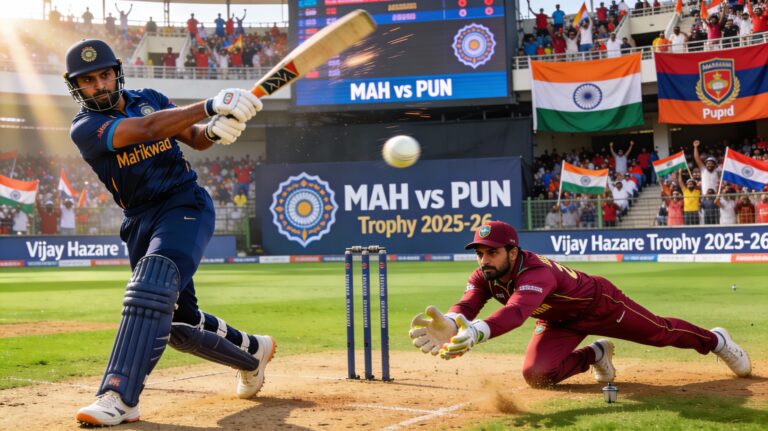

Ankit Sharma: Himachal Pradesh’s Rising All-Rounder in Indian Cricket
Ankit Sharma: The Quiet Ascent of Himachal Pradesh’s Modern All-Rounder
Introduction: When the Hills Produce Grit, Not Noise
Indian cricket has always had its loud stories—teenage prodigies, viral net sessions, overnight IPL sensations. But every so often, a different narrative emerges. It doesn’t announce itself with fireworks. It grows steadily, shaped by geography, discipline, and an unshakeable belief in process.

Ankit Sharma’s story belongs to that quieter tradition.
Born in 1998 and shaped by the competitive yet understated cricketing culture of Himachal Pradesh, Ankit Sharma is not a name built on hype. He is an all-rounder whose journey reflects what domestic Indian cricket still does best: produce resilient professionals who learn the game the hard way—season by season, match by match, mistake by mistake.
To understand Ankit Sharma is to understand a generation of cricketers who are not chasing instant fame, but sustained relevance. His career is still evolving, but already it offers insight into how modern Indian all-rounders are forged outside the traditional power centres.
Early Life and Background: Growing Up With Limited Spotlight
Himachal Pradesh has never been cricket’s loudest nursery. Unlike Mumbai, Delhi, or Karnataka, its cricketers grow up without constant attention, without endless media coverage, and often without elite infrastructure in their formative years.
Ankit Sharma grew up in this environment—where talent had to be self-driven, and ambition had to coexist with patience. Cricket was not an escape or a shortcut; it was a long-term commitment that demanded discipline.
From an early age, Ankit showed a natural inclination towards being involved in the game beyond just batting or bowling. Coaches noticed that he liked responsibility—bowling crucial overs, batting in pressure situations, contributing wherever the team needed him. That instinct would later shape his identity as an all-rounder.
Education and cricket ran parallel. Like many domestic cricketers, Ankit’s early years were about balance—training before school, matches on weekends, long travel hours, and the quiet sacrifices families make without ever framing them as sacrifices.
Formative Years: Learning Cricket the Long Way
Before structured domestic cricket, there are nets on uneven grounds, tournaments with little coverage, and matches where performance is noticed only by those who matter.
Ankit Sharma’s formative years were built on these experiences.
Playing age-group cricket for Himachal Pradesh exposed him to a reality many young cricketers face: competition is intense, and opportunities are limited. You don’t get picked for promise alone. You get picked because you can be trusted.
It was during this phase that Ankit began shaping his dual skill set seriously. As an all-rounder, he had to justify his place twice over—runs had to matter, wickets had to count. There was no luxury of being “one for the future.”
Coaches describe him during these years as coachable and focused, someone willing to work on technical details rather than chase shortcuts. Whether it was tightening his bowling lengths or learning to construct innings instead of hitting through the line early, Ankit absorbed instruction without resistance.
Early Struggles: The Domestic Reality Check
The jump from age-group cricket to senior domestic cricket is often the most difficult transition in Indian cricket. Talent alone doesn’t bridge that gap; temperament does.
For Ankit Sharma, the early phase of senior domestic cricket came with predictable challenges. Facing seasoned professionals who knew how to expose impatience, learning to bowl on flatter tracks, understanding game situations where containment mattered more than aggression—these were lessons learned through experience, not theory.
There were seasons where opportunities were sporadic. Matches where contributions were modest. Performances that were solid but not spectacular. This is the phase where many promising players fade, frustrated by the lack of immediate recognition.
Ankit didn’t.
Instead, he doubled down on consistency. He focused on fitness, fielding standards, and being ready whenever the team required him. He understood that domestic cricket rewards reliability before brilliance.
Breakthrough Moments: Trust Earned, Not Given
Every domestic cricketer remembers the phase when the team begins to trust them—not because of one performance, but because of repeated competence.
For Ankit Sharma, that trust came gradually. He began to be used more strategically—as a bowler in the middle overs, as a batter capable of stabilising an innings or accelerating when required.
His performances for Himachal Pradesh may not always have made headlines, but within the domestic circuit, they started to register. Teammates relied on him. Coaches valued his adaptability.
Importantly, he showed temperament in pressure situations—an underrated skill in domestic cricket, where matches often hinge on small moments rather than dramatic collapses.
These were not viral breakthroughs. They were professional ones.
Career Journey: Becoming a Reliable All-Round Option
As Ankit Sharma’s domestic career progressed, his role within the Himachal Pradesh setup became clearer. He was no longer just a squad member; he was a utility player teams value deeply.
His batting evolved from simply contributing runs to understanding match contexts—when to anchor, when to rotate strike, when to take calculated risks. His bowling, meanwhile, became more controlled, focused on accuracy and discipline rather than searching for magic deliveries.
In modern domestic cricket, where teams increasingly value balance, Ankit fit the template of the contemporary all-rounder. He wasn’t flashy, but he was functional in the best sense of the word.
Selection panels look for such profiles—players who don’t disrupt team combinations, who add depth, and who can be trusted across formats.
Work Ethic and Values: Built for the Long Game
Ask those who have worked with Ankit Sharma, and the conversation often returns to his professionalism.
He is not known for emotional highs or visible frustration. His preparation is methodical. His training routines are consistent. Fitness is treated as a baseline, not an afterthought.
As an all-rounder, Ankit understands that workload management is critical. Bowling and batting both demand physical and mental energy, and balancing the two requires discipline.
Leadership, in his case, is quiet. He leads by example rather than instruction. Younger players observe rather than listen—and often learn more that way.
Contributions to Himachal Pradesh Cricket
Himachal Pradesh’s rise as a competitive domestic unit over the past decade has been driven by players who understand teamwork over individual stardom. Ankit Sharma fits comfortably into this culture.
His contributions go beyond numbers. He provides balance. He allows captains flexibility. He strengthens the middle order and lengthens the bowling attack.
In a domestic ecosystem where resources are not unlimited, players like Ankit become invaluable—not because they dominate headlines, but because they make teams functional.
Public Image and Media Presence: A Cricketer Without Noise
Unlike many modern athletes, Ankit Sharma does not cultivate an aggressive public persona. He is not omnipresent on social media. He does not frame every performance as a statement.
This has its disadvantages in an era driven by visibility. But it also allows him to remain focused.
Among cricket followers who track domestic competitions closely, he is respected. Among casual fans, he is still emerging. And that’s often the most honest phase of a sporting career.
Challenges and Competition: Surviving a Crowded System
Indian cricket produces all-rounders in abundance. The competition is relentless.
For Ankit Sharma, the challenge is not just performance—it is differentiation. Standing out among dozens of capable professionals requires timing, opportunity, and sustained excellence.
Injuries, selection rotations, and format-specific demands all pose ongoing tests. Navigating these without losing momentum is one of the hardest aspects of a domestic cricketer’s life.
Ankit’s response so far has been pragmatic: focus on controllables, improve incrementally, stay match-ready.
Recent Developments and Current Phase
As of the current phase of his career, Ankit Sharma remains an active domestic professional, continuing to represent Himachal Pradesh and work towards greater consistency and impact.
His game continues to evolve, particularly in adapting to faster formats while retaining red-ball discipline. Like many in his cohort, he exists at the intersection of traditional domestic cricket and the modern T20-driven ecosystem.
Whether opportunities at higher levels come immediately or later, his trajectory reflects patience rather than urgency.
Personal Side: Grounded Beyond the Game
Away from the spotlight, Ankit Sharma is described as grounded and introspective. He values routine, family support, and mental clarity.
Cricket remains central, but not consuming. That balance—rare in competitive sport—helps sustain long careers.
Lessons From Ankit Sharma’s Journey
There are no shortcuts in his story. And that is precisely the lesson.
-
Consistency builds credibility
-
Versatility increases longevity
-
Patience outlasts hype
-
Professionalism matters more than promise
For aspiring cricketers, Ankit Sharma’s journey is a reminder that Indian cricket still rewards those willing to do the unglamorous work.
Conclusion: A Career Still Being Written
Ankit Sharma’s story is not about arrival. It is about progression.
At 26–27 years of age, his best years may still lie ahead. What he has already established is a professional identity rooted in discipline, adaptability, and quiet confidence.